learning outcomes: apply in everyday contexts skills developed through economic investigation demonstrate an…
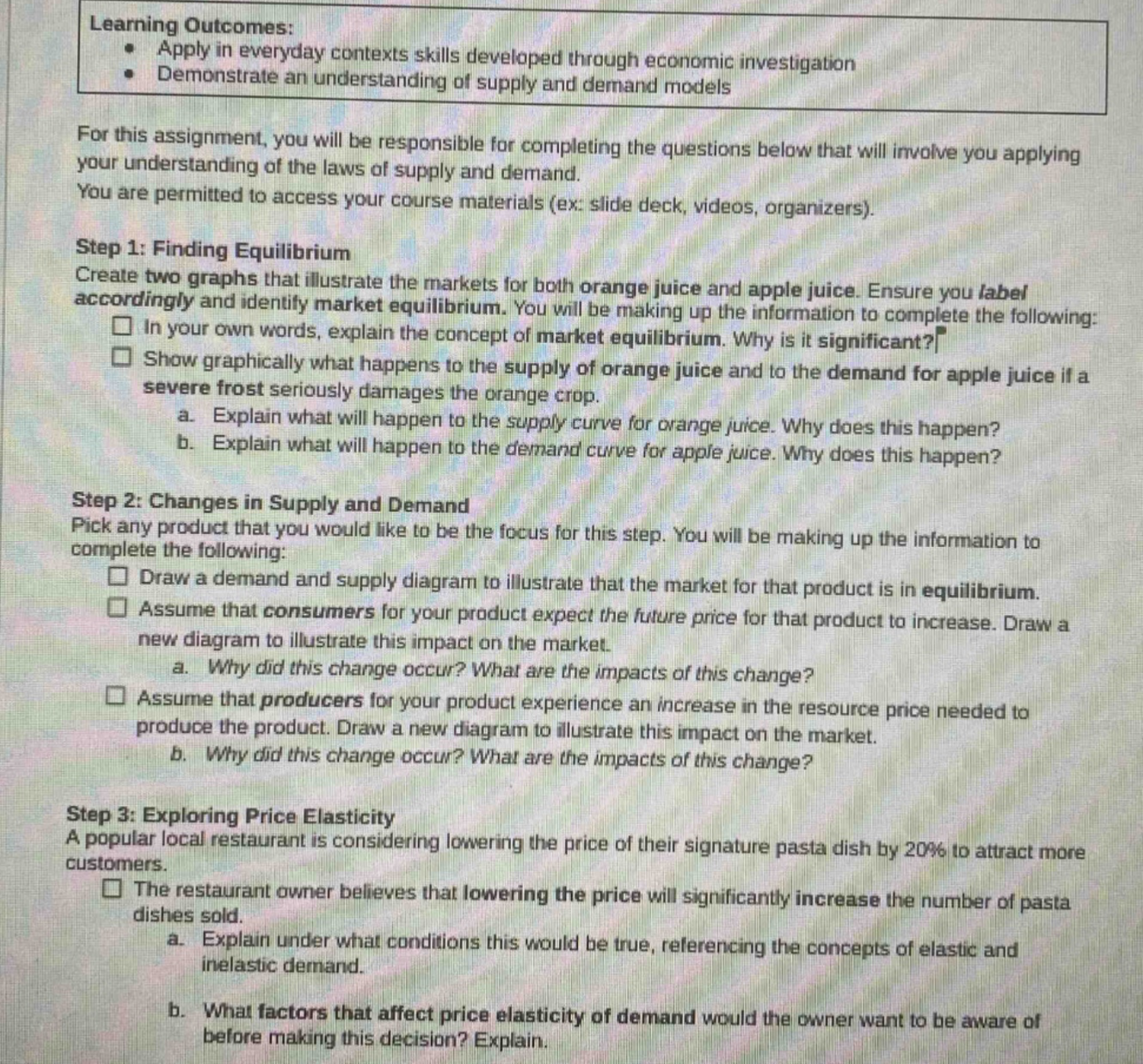
learning outcomes: apply in everyday contexts skills developed through economic investigation demonstrate an understanding of supply and demand models for this assignment, you will be responsible for completing the questions below that will involve you applying your understanding of the laws of supply and demand. you are permitted to access your course materials (ex: slide deck, videos, organizers). step 1: finding equilibrium create two graphs that illustrate the markets for both orange juice and apple juice. ensure you label accordingly and identify market equilibrium. you will be making up the information to complete the following: in your own words, explain the concept of market equilibrium. why is it significant? show graphically what happens to the supply of orange juice and to the demand for apple juice if a severe frost seriously damages the orange crop. a. explain what will happen to the supply curve for orange juice. why does this happen? b. explain what will happen to the demand curve for apple juice. why does this happen? step 2: changes in supply and demand pick any product that you would like to be the focus for this step. you will be making up the information to complete the following: draw a demand and supply diagram to illustrate that the market for that product is in equilibrium. assume that consumers for your product expect the future price for that product to increase. draw a new diagram to illustrate this impact on the market. a. why did this change occur? what are the impacts of this change? assume that producers for your product experience an increase in the resource price needed to produce the product. draw a new diagram to illustrate this impact on the market. b. why did this change occur? what are the impacts of this change? step 3: exploring price elasticity a popular local restaurant is considering lowering the price of their signature pasta dish by 20% to attract more customers. the restaurant owner believes that lowering the price will significantly increase the number of pasta dishes sold. a. explain under what conditions this would be true, referencing the concepts of elastic and inelastic demand. b. what factors that affect price elasticity of demand would the owner want to be aware of before making this decision? explain.
Answer
Brief Explanations:
- Market Equilibrium: It is the point where quantity demanded equals quantity supplied. It's significant as it determines the market - clearing price and quantity. In case of orange juice and apple juice, when a severe frost damages the orange crop:
- Orange Juice Supply Curve: The supply curve shifts leftward. This happens because the damage to the orange crop reduces the quantity of oranges available for juice production, decreasing the supply at each price level.
- Apple Juice Demand Curve: The demand curve shifts rightward. Since orange juice and apple juice are substitutes, as the supply of orange juice decreases and its price is likely to rise, consumers will demand more apple juice.
- Consumer Expectations: When consumers expect a future price increase for a product, they will demand more of it now. This shifts the demand curve rightward, increasing both the equilibrium price and quantity in the short - term.
- Producer Resource Price Increase: When producers face an increase in resource prices, the cost of production rises. This shifts the supply curve leftward, increasing the equilibrium price and decreasing the equilibrium quantity.
- Price Elasticity of Demand for Pasta Dish:
- True Condition: This would be true if the demand for the pasta dish is elastic. In elastic demand, a percentage change in price leads to a larger percentage change in quantity demanded. So, a 20% price decrease would lead to a more than 20% increase in quantity sold.
- Affecting Factors: The owner should consider factors like the availability of substitutes (more substitutes mean more elastic demand), the proportion of consumers' income spent on the dish (larger proportion means more elastic demand), and the time horizon (demand is more elastic in the long - run).
Answer:
- Market equilibrium is where quantity demanded = quantity supplied. It sets market - clearing price and quantity. Orange juice supply curve shifts left due to crop damage. Apple juice demand curve shifts right as it's a substitute.
- When consumers expect price increase, demand curve shifts right, raising price and quantity. When producer resource price increases, supply curve shifts left, raising price and lowering quantity.
- Lowering price increases quantity sold if demand is elastic. Owner should consider substitutes, income proportion, and time horizon for price elasticity of demand.