a limited - edition poster increases in value each year with an initial value of $18. after 1 year and an…
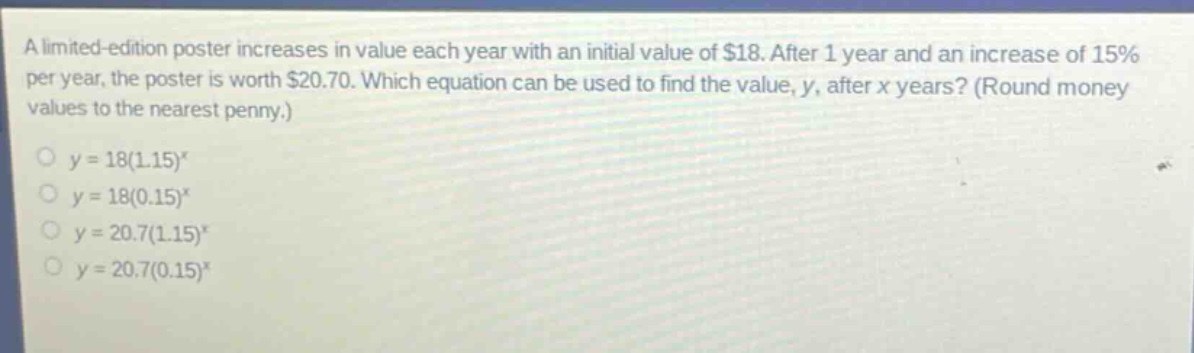
a limited - edition poster increases in value each year with an initial value of $18. after 1 year and an increase of 15% per year, the poster is worth $20.70. which equation can be used to find the value, y, after x years? (round money values to the nearest penny.)\n$y = 18(1.15)^x$\n$y = 18(0.15)^x$\n$y = 20.7(1.15)^x$\n$y = 20.7(0.15)^x$
Answer
Explanation:
Step1: Recall compound - growth formula
The formula for compound - growth is $y = a(1 + r)^x$, where $a$ is the initial amount, $r$ is the rate of growth as a decimal, and $x$ is the number of time periods.
Step2: Identify values of $a$ and $r$
The initial value of the poster $a=$18$, and the rate of increase $r = 15%=0.15$.
Step3: Substitute values into formula
Substituting $a = 18$ and $r=0.15$ into $y = a(1 + r)^x$, we get $y=18(1 + 0.15)^x=18(1.15)^x$.
Answer:
A. $y = 18(1.15)^x$