look at this monthly budget. monthly budget\n| | budgeted |\n|--|--| \n| net income | $600 |\n| total income…
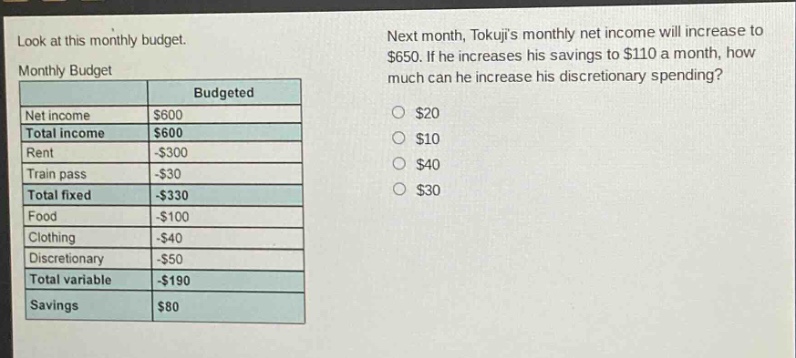
look at this monthly budget. monthly budget\n| | budgeted |\n|--|--| \n| net income | $600 |\n| total income | $600 |\n| rent | -$300 |\n| train pass | -$30 |\n| total fixed | -$330 |\n| food | -$100 |\n| clothing | -$40 |\n| discretionary | -$50 |\n| total variable | -$190 |\n| savings | $80 |\nnext month, tokujis monthly net income will increase to $650. if he increases his savings to $110 a month, how much can he increase his discretionary spending?\n$20\n$10\n$40\n$30
Answer
Explanation:
Step1: Calculate current total spending
Current net - income is $600$ and savings is $80$. So current total spending is $600 - 80=520$.
Step2: Calculate new total available for non - savings spending
New net income is $650$ and new savings is $110$. So new total available for non - savings spending is $650 - 110 = 540$.
Step3: Calculate increase in discretionary spending
The increase in non - savings spending is $540−520 = 20$.
Answer:
$20$