macroeconomics 2050, review exercises for exam 3\n1. answer the following questions about the keynesian…
macroeconomics 2050, review exercises for exam 3\n1. answer the following questions about the keynesian model depicted in the figure.\n- what are the autonomous expenditures in the keynesian model? what is the meaning of autonomous expenditures in the model?\n- what is the meaning and significance of the 45 degrees line?\n- where is equilibrium income in the graph?\n- what will happen to aggregate expenditure line if hypothetically the level of investment increases from 400 bil. to 500 bil.?
Answer
Brief Explanations:
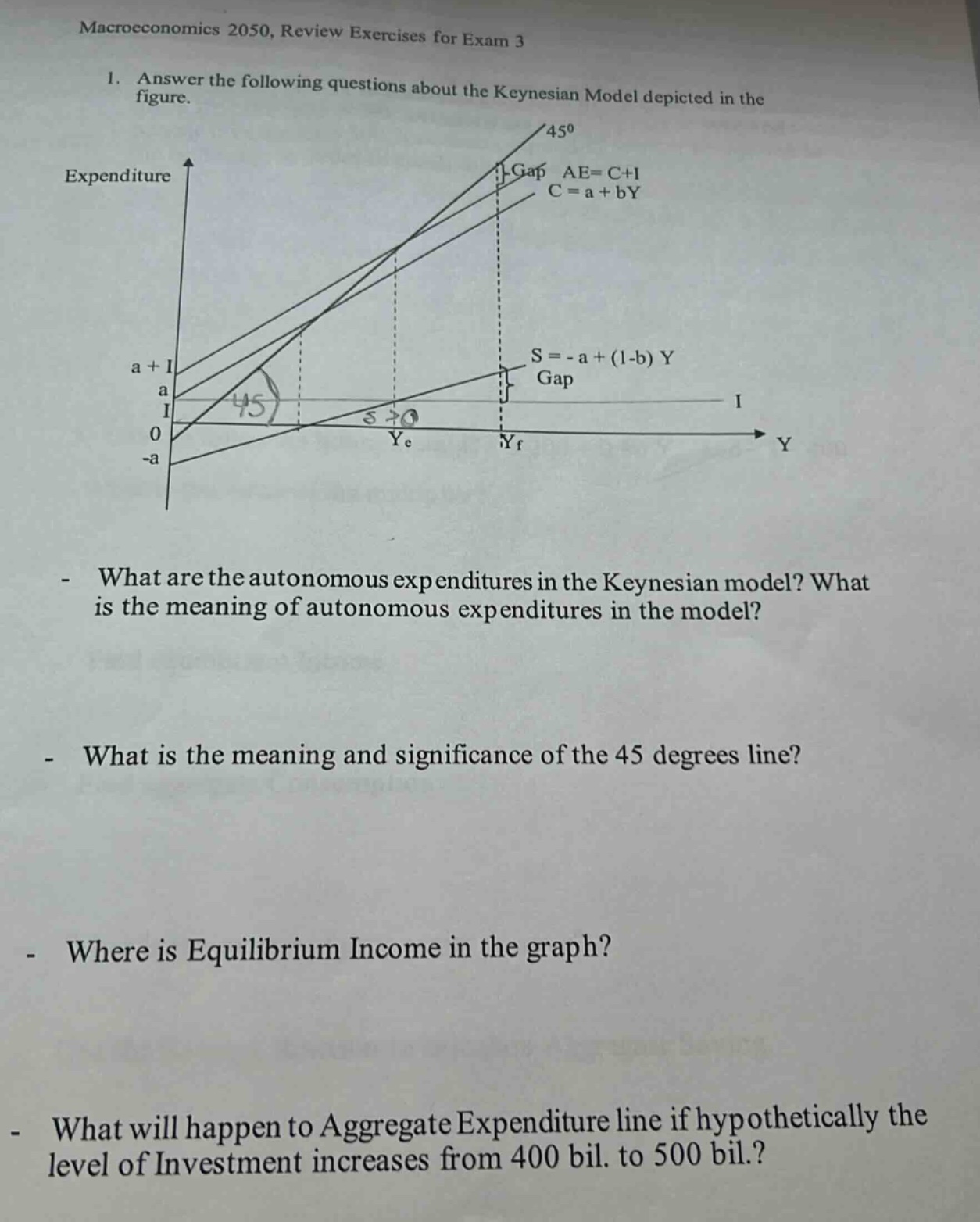
- Autonomous expenditures in the Keynesian model are expenditures that do not depend on the level of income. In the given model, $a$ (autonomous - consumption) and $I$ (investment) are autonomous expenditures. They are the spending that would occur even if income ($Y$) were zero.
- The 45 - degree line represents all points where aggregate expenditure (AE) equals income ($Y$). It serves as a reference line to find the equilibrium level of income in the economy. At any point on this line, $AE = Y$.
- Equilibrium income in the graph is at the point where the aggregate - expenditure line ($AE = C + I$) intersects the 45 - degree line. In the graph, it is at $Y_e$.
- If the level of investment increases from 400 bil. to 500 bil., the aggregate - expenditure line ($AE = C+I$) will shift upward by the amount of the increase in investment (100 bil.). This is because investment is a component of aggregate expenditure, and an increase in investment directly adds to aggregate expenditure at each level of income.
Answer:
- Autonomous expenditures are $a$ and $I$. They are expenditures independent of income level.
- The 45 - degree line represents points where $AE = Y$, used to find equilibrium income.
- Equilibrium income is at $Y_e$ (the intersection of $AE$ and the 45 - degree line).
- The aggregate - expenditure line will shift upward by 100 bil.