mark buys a used car for $12,000. the value of the car depreciates 10% per year from the time he bought the…
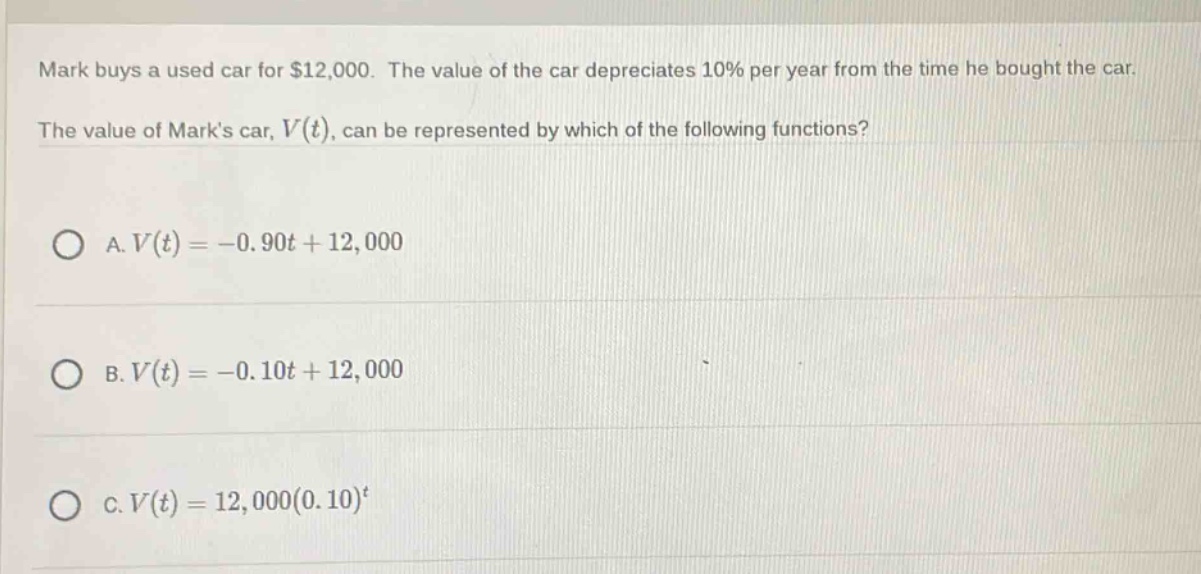
mark buys a used car for $12,000. the value of the car depreciates 10% per year from the time he bought the car. the value of marks car, v(t), can be represented by which of the following functions? a. v(t)= - 0.90t + 12,000 b. v(t)= - 0.10t + 12,000 c. v(t)=12,000(0.10)^t
Answer
Explanation:
Step1: Recall depreciation - formula
The formula for exponential - decay is $V(t)=V_0(1 - r)^t$, where $V_0$ is the initial value, $r$ is the rate of depreciation, and $t$ is the time in years.
Step2: Identify the values of $V_0$ and $r$
Given that $V_0 = 12000$ (the initial value of the car) and $r=0.1$ (10% depreciation rate).
Step3: Substitute the values into the formula
Substitute $V_0 = 12000$ and $r = 0.1$ into $V(t)=V_0(1 - r)^t$. We get $V(t)=12000(1 - 0.1)^t=12000(0.9)^t$. Let's analyze each option:
- Option A: $V(t)=-0.90t + 12000$ is a linear function, not an exponential - decay function for depreciation.
- Option B: $V(t)=-0.10t + 12000$ is a linear function, not an exponential - decay function for depreciation.
- Option C: $V(t)=12000(0.10)^t$ is incorrect because the base of the exponential should be $1 - r=0.9$ instead of $r = 0.1$.
The correct formula for the value of the car's depreciation is $V(t)=12000(0.9)^t$, but since it's not among the options, we assume there is a mis - typing in the options and the closest conceptually correct one is based on the understanding of the exponential decay formula.