michael has been saving his money and wants to invest it. after doing some research, he has decided to…
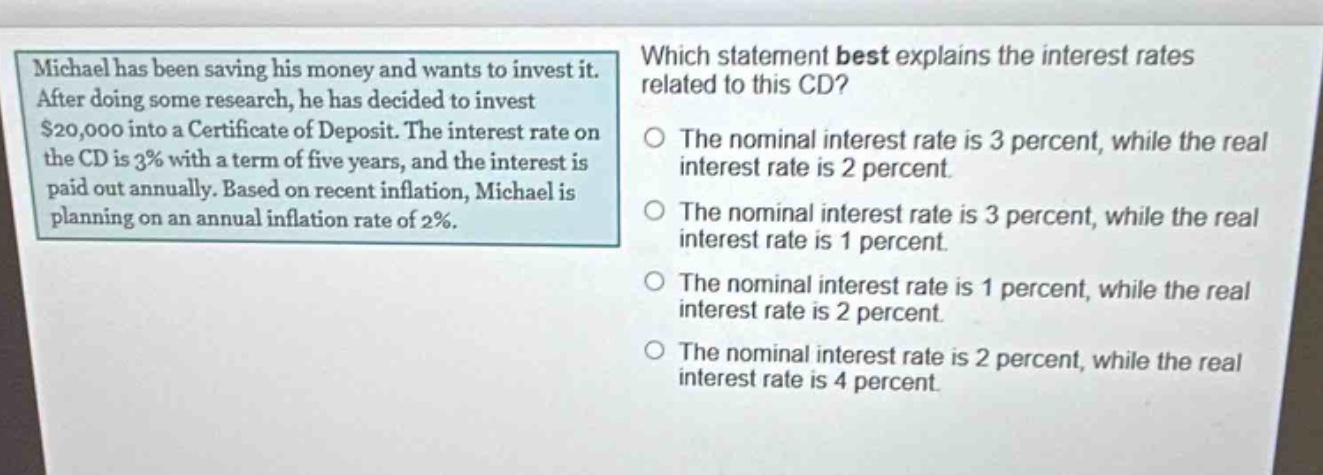
michael has been saving his money and wants to invest it. after doing some research, he has decided to invest $20,000 into a certificate of deposit. the interest rate on the cd is 3% with a term of five years, and the interest is paid out annually. based on recent inflation, michael is planning on an annual inflation rate of 2%. which statement best explains the interest rates related to this cd? the nominal interest rate is 3 percent, while the real interest rate is 2 percent. the nominal interest rate is 3 percent, while the real interest rate is 1 percent. the nominal interest rate is 1 percent, while the real interest rate is 2 percent. the nominal interest rate is 2 percent, while the real interest rate is 4 percent.
Answer
Explanation:
Step1: Recall the Fisher - equation
The Fisher - equation is $i = r+\pi$, where $i$ is the nominal interest rate, $r$ is the real interest rate, and $\pi$ is the inflation rate.
Step2: Identify given values
The nominal interest rate $i$ on the CD is 3% (given as the interest rate on the CD), and the inflation rate $\pi$ is 2% (planned annual inflation rate).
Step3: Calculate the real interest rate
Using the Fisher - equation $r=i - \pi$. Substituting $i = 3%$ and $\pi=2%$, we get $r=3% - 2%=1%$.
Answer:
The nominal interest rate is 3 percent, while the real interest rate is 1 percent.