miguel invested $400 in a bank account that pays interest. the accounts value over time, in x years, is…
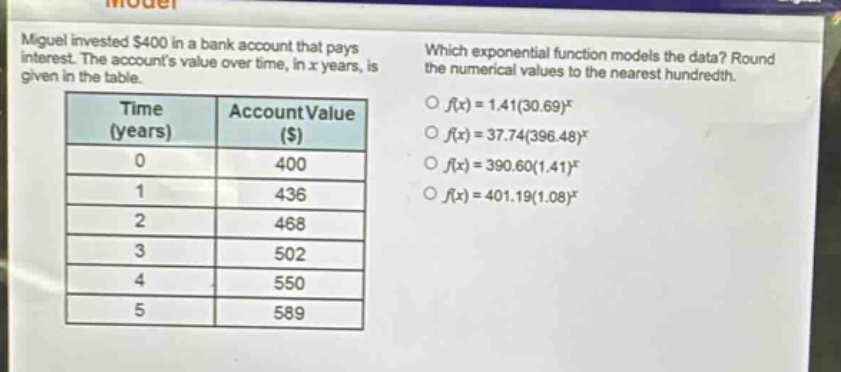
miguel invested $400 in a bank account that pays interest. the accounts value over time, in x years, is given in the table. which exponential function models the data? round the numerical values to the nearest hundredth. time (years) account value ($) 0 400 1 436 2 468 3 502 4 550 5 589 f(x)=1.41(30.69)^x f(x)=37.74(396.48)^x f(x)=390.60(1.41)^x f(x)=401.19(1.08)^x
Answer
Explanation:
Step1: Recall exponential - function form
The general form of an exponential function is $f(x)=a(b)^{x}$, where $a$ is the initial value and $b$ is the growth factor. When $x = 0$, $f(0)=a$.
Step2: Determine the initial value
From the table, when $x = 0$, the account - value $y=f(0)=400$. So, $a = 400$.
Step3: Calculate the growth factor for each option
For option 1: $f(x)=1.41(30.69)^{x}$, when $x = 0$, $f(0)=1.41\times(30.69)^{0}=1.41\neq400$. For option 2: $f(x)=37.74(396.48)^{x}$, when $x = 0$, $f(0)=37.74\times(396.48)^{0}=37.74\neq400$. For option 3: $f(x)=390.60(1.41)^{x}$, when $x = 0$, $f(0)=390.60\times(1.41)^{0}=390.60\neq400$. For option 4: $f(x)=401.19(1.08)^{x}$, when $x = 0$, $f(0)=401.19\times(1.08)^{0}=401.19\approx400$. Let's check the growth for $x = 1$. For $f(x)=401.19(1.08)^{x}$, when $x = 1$, $f(1)=401.19\times1.08 = 401.19\times(1 + 0.08)=401.19+401.19\times0.08=401.19 + 32.0952=433.2852\approx436$.
Answer:
$f(x)=401.19(1.08)^{x}$