mongolia, which, according to international indices, has relatively strong democratic institutions and low…
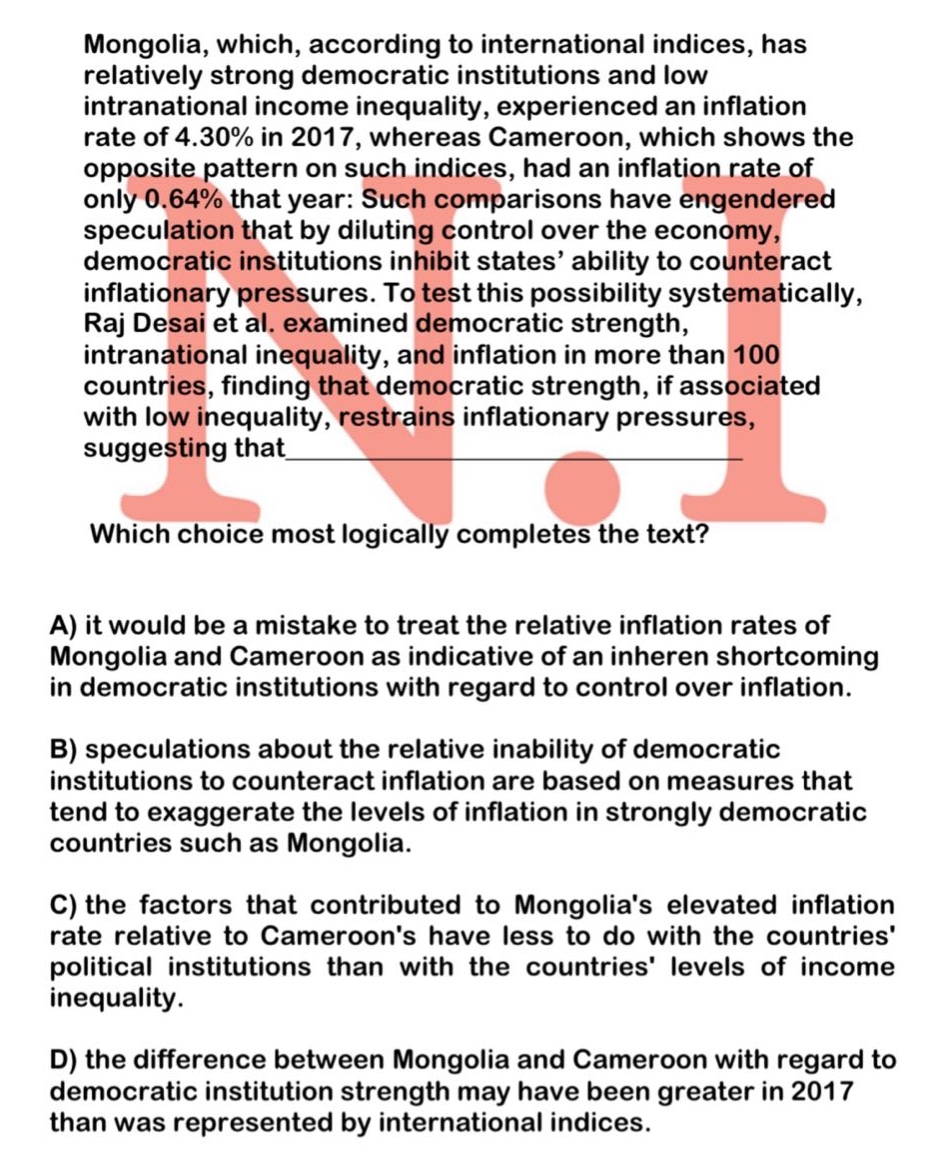
mongolia, which, according to international indices, has relatively strong democratic institutions and low intranational income inequality, experienced an inflation rate of 4.30% in 2017, whereas cameroon, which shows the opposite pattern on such indices, had an inflation rate of only 0.64% that year: such comparisons have engendered speculation that by diluting control over the economy, democratic institutions inhibit states’ ability to counteract inflationary pressures. to test this possibility systematically, raj desai et al. examined democratic strength, intranational inequality, and inflation in more than 100 countries, finding that democratic strength, if associated with low inequality, restrains inflationary pressures, suggesting that\nwhich choice most logically completes the text?\na) it would be a mistake to treat the relative inflation rates of mongolia and cameroon as indicative of an inheren shortcoming in democratic institutions with regard to control over inflation.\nb) speculations about the relative inability of democratic institutions to counteract inflation are based on measures that tend to exaggerate the levels of inflation in strongly democratic countries such as mongolia.\nc) the factors that contributed to mongolias elevated inflation rate relative to cameroons have less to do with the countries political institutions than with the countries levels of income inequality.\nd) the difference between mongolia and cameroon with regard to democratic institution strength may have been greater in 2017 than was represented by international indices.
Answer
Brief Explanations:
The text first presents a speculation that democratic institutions inhibit states' ability to counter - act inflationary pressures. Then it shows that Raj Desai et al.'s study found that democratic strength, when associated with low inequality, restrains inflationary pressures. This means the initial speculation about democratic institutions being unable to counter - inflation is wrong. Option A correctly concludes that it's a mistake to consider the inflation rates of Mongolia and Cameroon as evidence of an inherent shortcoming of democratic institutions in controlling inflation. Option B is wrong as there's no mention of measures exaggerating inflation in democratic countries. Option C goes against the study's finding that democratic strength and inequality are related to inflation. Option D is not relevant to the main conclusion about the relationship between democratic institutions and inflation.
Answer:
A. it would be a mistake to treat the relative inflation rates of Mongolia and Cameroon as indicative of an inherent shortcoming in democratic institutions with regard to control over inflation.