how much would you have to deposit in an account with a 5% interest rate, compounded annually, to have $1300…
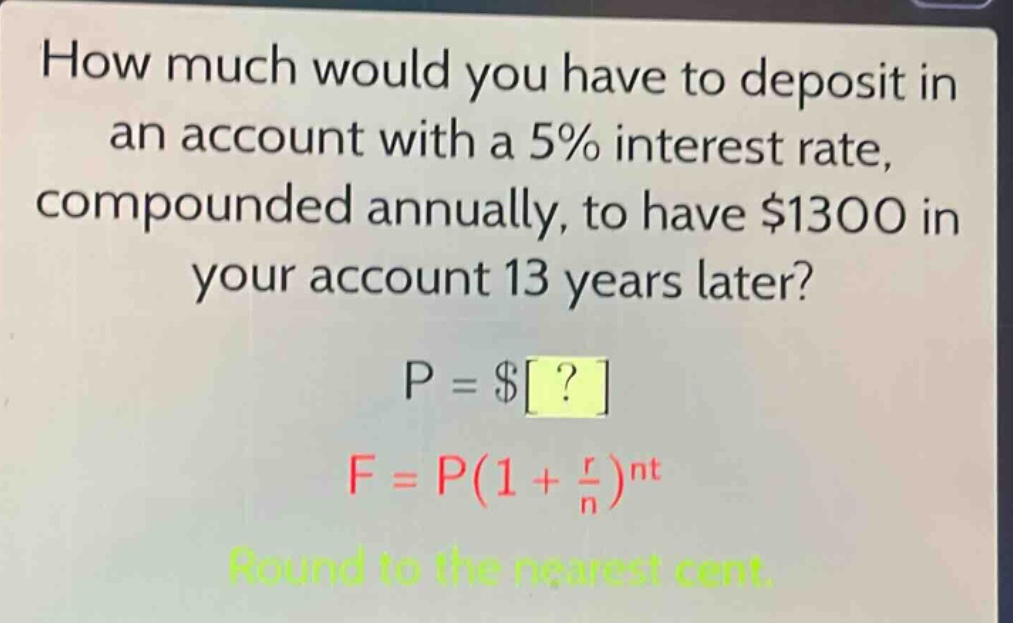
how much would you have to deposit in an account with a 5% interest rate, compounded annually, to have $1300 in your account 13 years later?\np = $?\nf = p(1 + \\frac{r}{n})^{nt}\nround to the nearest cent.
Answer
Explanation:
Step1: Identify the values
We know that $F = 1300$, $r=0.05$ (since 5% = 0.05), $n = 1$ (compounded annually), and $t = 13$. The compound - interest formula is $F=P(1 +\frac{r}{n})^{nt}$.
Step2: Rearrange the formula for $P$
Starting from $F = P(1+\frac{r}{n})^{nt}$, we can solve for $P$ by dividing both sides of the equation by $(1+\frac{r}{n})^{nt}$. So, $P=\frac{F}{(1 +\frac{r}{n})^{nt}}$.
Step3: Substitute the values
Substitute $F = 1300$, $r = 0.05$, $n = 1$, and $t = 13$ into the formula for $P$. We get $P=\frac{1300}{(1+\frac{0.05}{1})^{1\times13}}=\frac{1300}{(1 + 0.05)^{13}}$.
Step4: Calculate $(1 + 0.05)^{13}$
$(1 + 0.05)^{13}=1.05^{13}\approx1.885649$.
Step5: Calculate $P$
$P=\frac{1300}{1.885649}\approx689.43$.
Answer:
$689.43$