2 new york city subways 25 points\nthe new york city subway system occasionally experiences disruptions due…
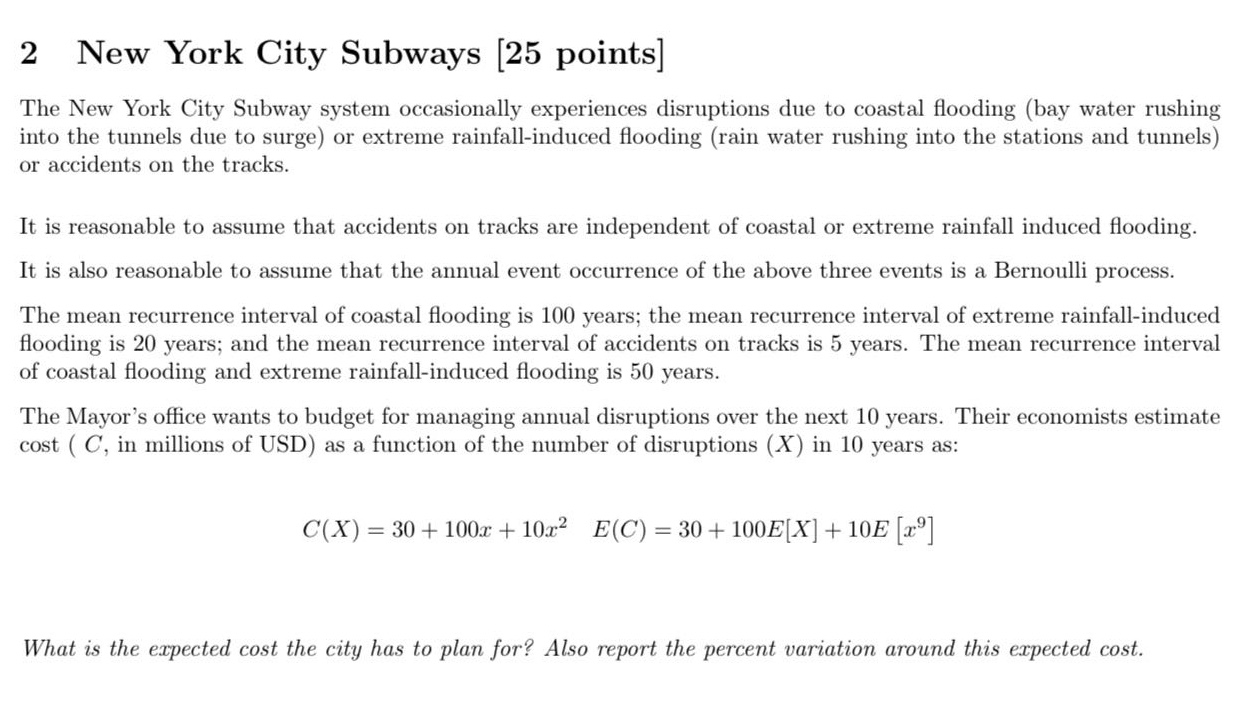
2 new york city subways 25 points\nthe new york city subway system occasionally experiences disruptions due to coastal flooding (bay water rushing into the tunnels due to surge) or extreme rainfall - induced flooding (rain water rushing into the stations and tunnels) or accidents on the tracks.\nit is reasonable to assume that accidents on tracks are independent of coastal or extreme rainfall induced flooding.\nit is also reasonable to assume that the annual event occurrence of the above three events is a bernoulli process.\nthe mean recurrence interval of coastal flooding is 100 years; the mean recurrence interval of extreme rainfall - induced flooding is 20 years; and the mean recurrence interval of accidents on tracks is 5 years. the mean recurrence interval of coastal flooding and extreme rainfall - induced flooding is 50 years.\nthe mayor’s office wants to budget for managing annual disruptions over the next 10 years. their economists estimate cost (c, in millions of usd) as a function of the number of disruptions (x) in 10 years as:\nc(x)=30 + 100x+10x² e(c)=30 + 100ex+10ex⁹\nwhat is the expected cost the city has to plan for? also report the percent variation around this expected cost.
Answer
Explanation:
Step1: Calculate probabilities of individual events
The probability of an event in a Bernoulli - process is the reciprocal of its mean recurrence interval. Let $p_1$ be the probability of coastal flooding, $p_1=\frac{1}{100}$; $p_2$ be the probability of extreme - rainfall induced flooding, $p_2 = \frac{1}{20}$; $p_3$ be the probability of track accidents, $p_3=\frac{1}{5}$. The probability of both coastal and extreme - rainfall induced flooding is $p_{12}=\frac{1}{50}$.
Step2: Calculate the probability of any disruption in a year
Using the inclusion - exclusion principle, the probability of a disruption in a year $p$ is: $p=p_1 + p_2+p_3 - p_{12}$ $p=\frac{1}{100}+\frac{1}{20}+\frac{1}{5}-\frac{1}{50}$ $p=\frac{1 + 5+20 - 2}{100}=\frac{24}{100}=0.24$.
Step3: Calculate the expected number of disruptions in 10 years
Since the number of disruptions $X$ in 10 years follows a binomial distribution $X\sim B(n = 10,p = 0.24)$, the expected value $E[X]=np$. $E[X]=10\times0.24 = 2.4$.
Step4: Calculate $E[X^{2}]$ for a binomial distribution
For a binomial distribution $X\sim B(n,p)$, $E[X^{2}]=np(1 - p)+n^{2}p^{2}$. $E[X^{2}]=10\times0.24\times(1 - 0.24)+10^{2}\times0.24^{2}$ $E[X^{2}]=10\times0.24\times0.76 + 100\times0.0576$ $E[X^{2}]=1.824+5.76=7.584$.
Step5: Calculate the expected cost
We know that $E(C)=30 + 100E[X]+10E[X^{2}]$. $E(C)=30+100\times2.4 + 10\times7.584$ $E(C)=30+240+75.84$ $E(C)=345.84$ (in millions of USD).
Step6: Calculate the variance of $X$
For a binomial distribution $X\sim B(n,p)$, $Var(X)=np(1 - p)$. $Var(X)=10\times0.24\times(1 - 0.24)=1.824$. The standard deviation $\sigma=\sqrt{Var(X)}=\sqrt{1.824}\approx1.35$. The percent variation is $\frac{\sigma}{E[X]}\times100=\frac{1.35}{2.4}\times100 = 56.25%$.
Answer:
The expected cost is $345.84$ million USD and the percent variation around this expected cost is $56.25%$.