4. numerical response\ncalculate the ph, to the nearest tenth, of a solution with a hydrogen - ion…
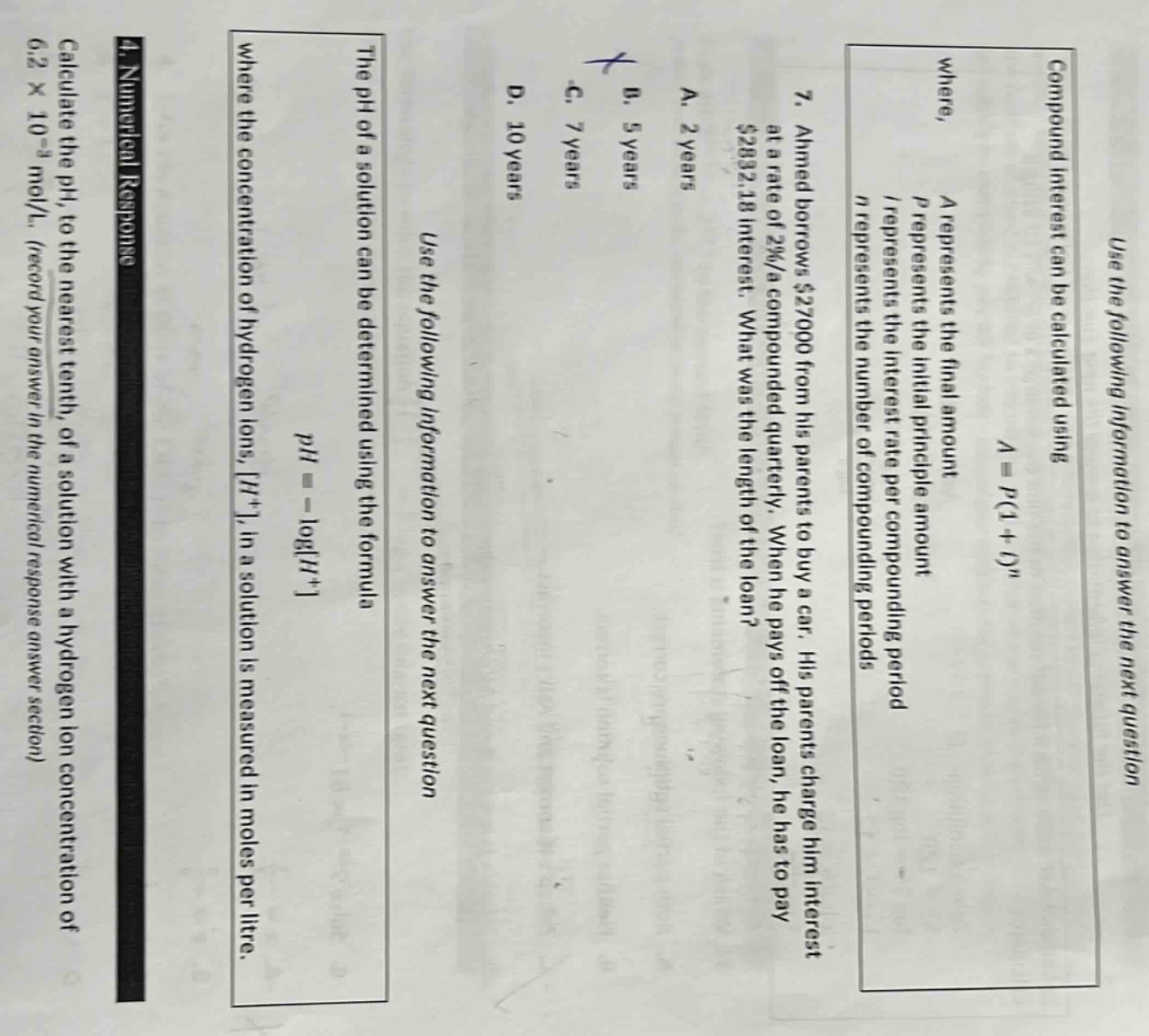
4. numerical response\ncalculate the ph, to the nearest tenth, of a solution with a hydrogen - ion concentration of 6.2×10⁻³ mol/l. (record your answer in the numerical response answer section)\nthe ph of a solution can be determined using the formula ph = -logh⁺\nwhere the concentration of hydrogen ions, h⁺, in a solution is measured in moles per litre.\nuse the following information to answer the next question\n7. almed borrows $27000 from his parents to buy a car. his parents charge him interest at a rate of 2%/a compounded quarterly. when he pays off the loan, he has to pay $28932.18 interest. what was the length of the loan?\na. 2 years\nb. 5 years\nc. 7 years\nd. 10 years\ncompound interest can be calculated using a = p(1 + i)ⁿ\nwhere,\na represents the final amount\np represents the initial principle amount\ni represents the interest rate per compounding period\nn represents the number of compounding periods
Answer
Explanation:
Step1: Identify the formula for pH
The formula for pH is $pH = -\log[H^+]$. Given $[H^+]=6.2\times 10^{-3}\text{ mol/L}$.
Step2: Substitute the value into the formula
$pH=-\log(6.2\times 10^{-3})$. Using the property of logarithms $\log(ab)=\log a+\log b$, we have $pH = -(\log6.2+\log(10^{-3}))$. Since $\log(10^{-3})=- 3$ and $\log6.2\approx0.792$, then $pH=- (0.792 - 3)$.
Step3: Calculate the pH value
$pH=-0.792 + 3=2.208\approx2.2$.
Answer:
$2.2$