a profit formula for dining plates from the previous year was modeled by the function $p(d)=-15d^{2}+1,200d…
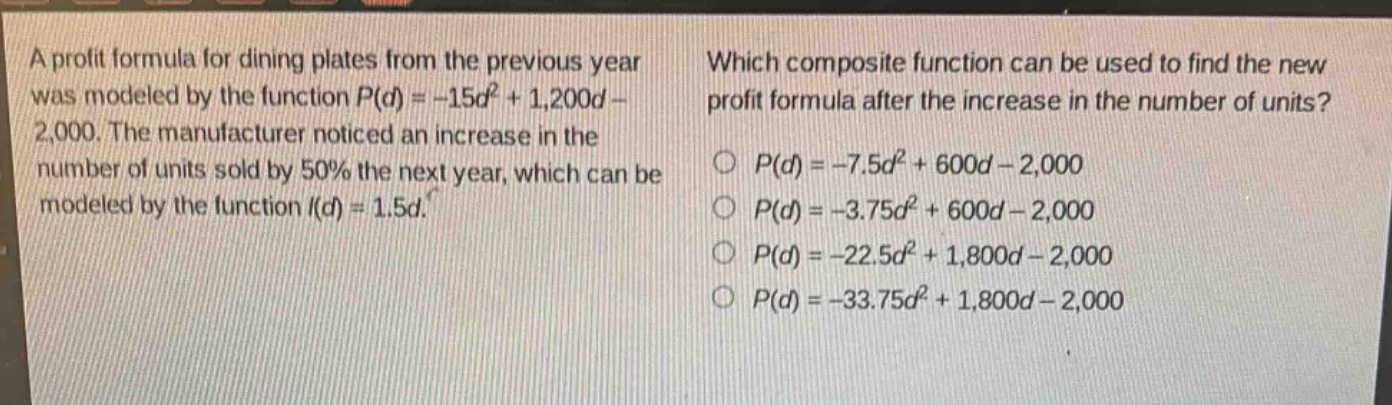
a profit formula for dining plates from the previous year was modeled by the function $p(d)=-15d^{2}+1,200d - 2,000$. the manufacturer noticed an increase in the number of units sold by 50% the next year, which can be modeled by the function $i(d)=1.5d$. which composite function can be used to find the new profit formula after the increase in the number of units? $p(d)=-7.5d^{2}+600d - 2,000$ $p(d)=-3.75d^{2}+600d - 2,000$ $p(d)=-22.5d^{2}+1,800d - 2,000$ $p(d)=-33.75d^{2}+1,800d - 2,000$
Answer
Explanation:
Step1: Encontrar la función compuesta
La función de ganancia original es $P(d)= - 15d^{2}+1200d - 2000$ y la función que representa el aumento en la cantidad vendida es $I(d)=1.5d$. Para encontrar la nueva función de ganancia, sustituimos $d$ en $P(d)$ por $I(d)$.
Step2: Realizar la sustitución
Sustituimos $d$ en $P(d)$ por $1.5d$: [ \begin{align*} P(I(d))&=-15(1.5d)^{2}+1200(1.5d)-2000\ &=-15\times2.25d^{2}+1800d - 2000\ &=-33.75d^{2}+1800d - 2000 \end{align*} ]
Answer:
$P(d)=-33.75d^{2}+1800d - 2000$ (la última opción)