question 12\nthis table illustrates the amount of output a given firm can produce using different…
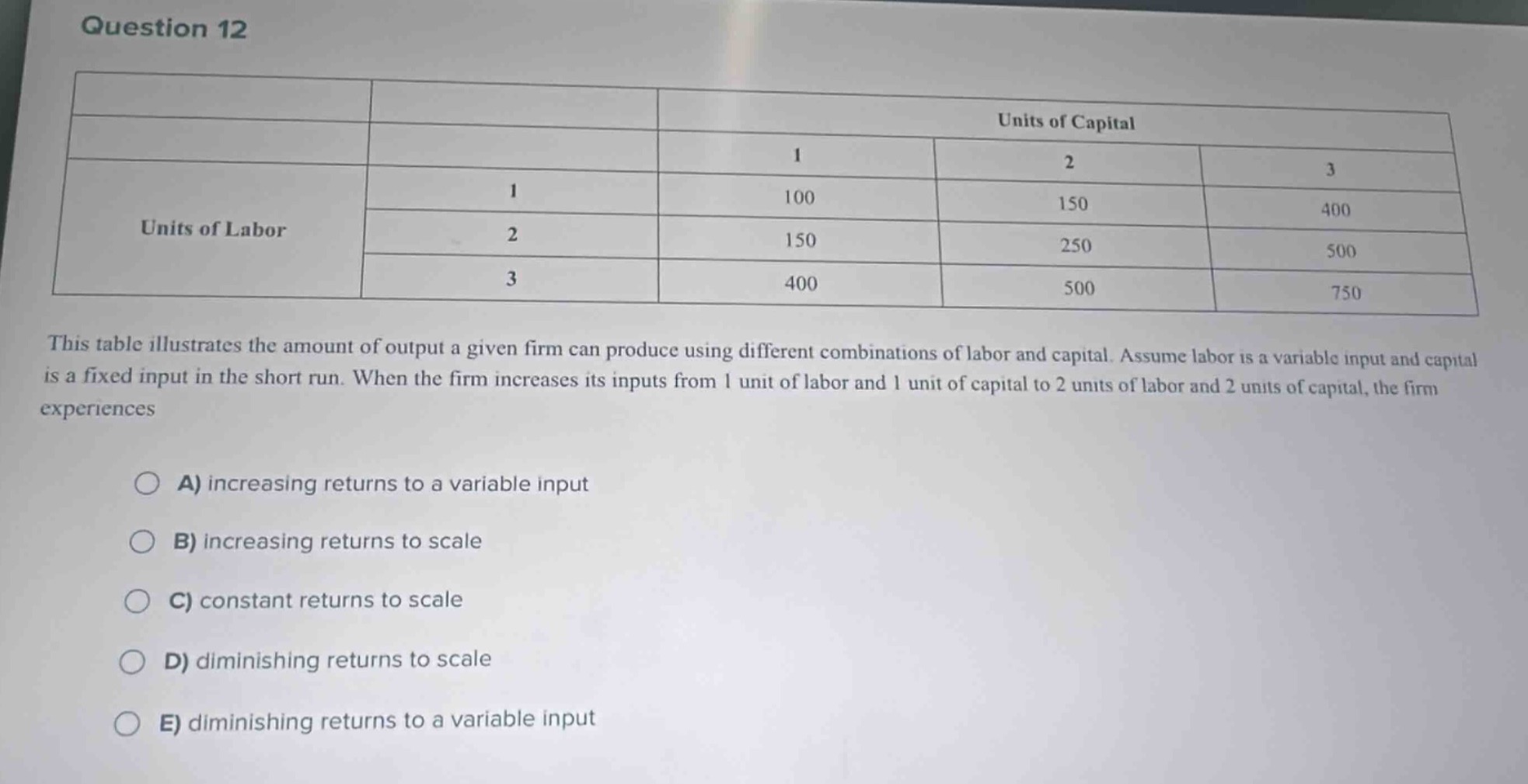
question 12\nthis table illustrates the amount of output a given firm can produce using different combinations of labor and capital. assume labor is a variable input and capital is a fixed input in the short run. when the firm increases its inputs from 1 unit of labor and 1 unit of capital to 2 units of labor and 2 units of capital, the firm experiences\na) increasing returns to a variable input\nb) increasing returns to scale\nc) constant returns to scale\nd) diminishing returns to scale\ne) diminishing returns to a variable input
Answer
Brief Explanations:
Returns - to - scale refers to the rate at which output changes in response to proportional changes in all inputs. When 1 unit of labor and 1 unit of capital produce 100 units of output, and 2 units of labor and 2 units of capital produce 250 units of output. The proportionate increase in inputs is 100% (from 1 to 2 for both labor and capital), and the proportionate increase in output is $\frac{250 - 100}{100}\times100%=150%$. Since output increases by a larger proportion than the increase in inputs, it is increasing returns to scale.
Answer:
B. increasing returns to scale