question 5\n0/1 pt 100 99 details\na wooden artifact from an ancient tomb contains 20 percent of the carbon…
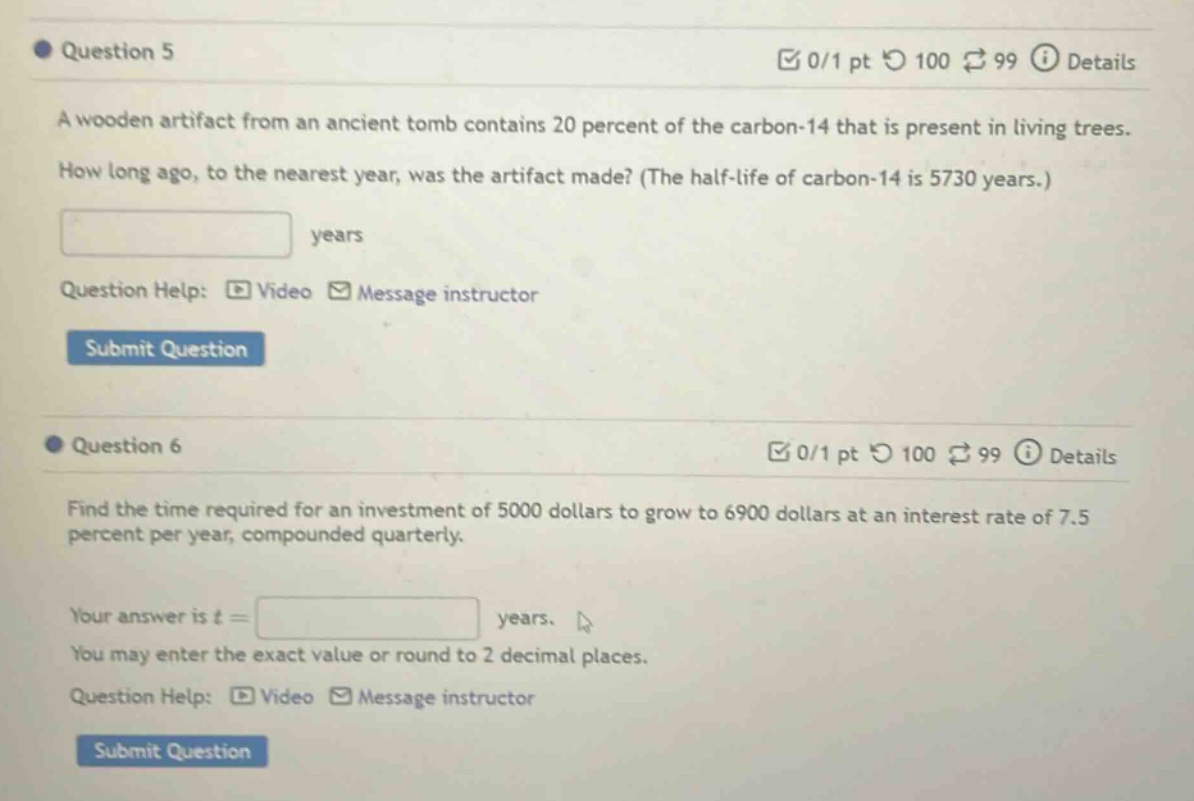
question 5\n0/1 pt 100 99 details\na wooden artifact from an ancient tomb contains 20 percent of the carbon - 14 that is present in living trees.\nhow long ago, to the nearest year, was the artifact made? (the half - life of carbon - 14 is 5730 years.)\nyears\nquestion help: video message instructor\nsubmit question\nquestion 6\n0/1 pt 100 99 details\nfind the time required for an investment of 5000 dollars to grow to 6900 dollars at an interest rate of 7.5 percent per year, compounded quarterly.\nyour answer is t = \nyears.\nyou may enter the exact value or round to 2 decimal places.\nquestion help: video message instructor\nsubmit question
Answer
Question 5
Explanation:
Step1: Write the radioactive - decay formula
The formula for radioactive decay is $N(t)=N_0\left(\frac{1}{2}\right)^{\frac{t}{T_{1/2}}}$, where $N(t)$ is the amount of the substance at time $t$, $N_0$ is the initial amount of the substance, $T_{1/2}$ is the half - life of the substance. We know that $N(t) = 0.2N_0$ and $T_{1/2}=5730$ years. Substituting these values into the formula gives $0.2N_0=N_0\left(\frac{1}{2}\right)^{\frac{t}{5730}}$. Since $N_0\neq0$, we can divide both sides of the equation by $N_0$ to get $0.2=\left(\frac{1}{2}\right)^{\frac{t}{5730}}$.
Step2: Take the natural logarithm of both sides
$\ln(0.2)=\ln\left(\left(\frac{1}{2}\right)^{\frac{t}{5730}}\right)$. Using the property of logarithms $\ln(a^b)=b\ln(a)$, we have $\ln(0.2)=\frac{t}{5730}\ln\left(\frac{1}{2}\right)$.
Step3: Solve for $t$
$t = 5730\times\frac{\ln(0.2)}{\ln\left(\frac{1}{2}\right)}$. We know that $\ln(0.2)\approx - 1.6094$ and $\ln\left(\frac{1}{2}\right)\approx-0.6931$. Then $t = 5730\times\frac{- 1.6094}{-0.6931}\approx13269$.
Answer:
$13269$
Question 6
Explanation:
Step1: Write the compound - interest formula
The compound - interest formula is $A = P\left(1+\frac{r}{n}\right)^{nt}$, where $A$ is the final amount, $P$ is the principal amount, $r$ is the annual interest rate (in decimal form), $n$ is the number of times interest is compounded per year, and $t$ is the number of years. Here, $P = 5000$, $A = 6900$, $r=0.075$, and $n = 4$ (compounded quarterly). Substitute these values into the formula: $6900=5000\left(1+\frac{0.075}{4}\right)^{4t}$.
Step2: Simplify the equation
First, divide both sides by $5000$: $\frac{6900}{5000}=\left(1 + 0.01875\right)^{4t}$, so $1.38=(1.01875)^{4t}$.
Step3: Take the natural logarithm of both sides
$\ln(1.38)=\ln((1.01875)^{4t})$. Using the property $\ln(a^b)=b\ln(a)$, we get $\ln(1.38)=4t\ln(1.01875)$.
Step4: Solve for $t$
$t=\frac{\ln(1.38)}{4\ln(1.01875)}$. Since $\ln(1.38)\approx0.3221$ and $\ln(1.01875)\approx0.0186$, then $t=\frac{0.3221}{4\times0.0186}=\frac{0.3221}{0.0744}\approx4.33$.
Answer:
$4.33$