read the following excerpt from levitt and dubners freakonomics. there is a tale, “the ring of gyges,” that…
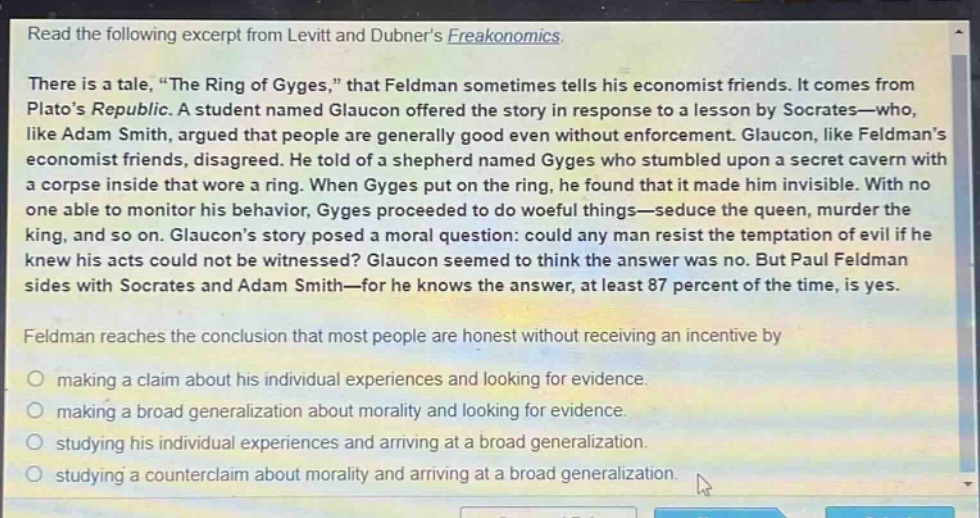
read the following excerpt from levitt and dubners freakonomics. there is a tale, “the ring of gyges,” that feldman sometimes tells his economist friends. it comes from platos republic. a student named glaucon offered the story in response to a lesson by socrates—who, like adam smith, argued that people are generally good even without enforcement. glaucon, like feldmans economist friends, disagreed. he told of a shepherd named gyges who stumbled upon a secret cavern with a corpse inside that wore a ring. when gyges put on the ring, he found that it made him invisible. with no one able to monitor his behavior, gyges proceeded to do woeful things—seduce the queen, murder the king, and so on. glaucons story posed a moral question: could any man resist the temptation of evil if he knew his acts could not be witnessed? glaucon seemed to think the answer was no. but paul feldman sides with socrates and adam smith—for he knows the answer, at least 87 percent of the time, is yes. feldman reaches the conclusion that most people are honest without receiving an incentive by making a claim about his individual experiences and looking for evidence. making a broad generalization about morality and looking for evidence. studying his individual experiences and arriving at a broad generalization. studying a counter - claim about morality and arriving at a broad generalization.
Answer
Brief Explanations:
Feldman uses his individual experiences (the story - telling and his own view) and then arrives at a broad generalization that most people are honest without an incentive. He doesn't just make a claim and look for evidence, nor does he start with a broad generalization about morality and then look for evidence. Also, he is not studying a counter - claim about morality to arrive at a generalization. He uses his own experiences to form a view.
Answer:
studying his individual experiences and arriving at a broad generalization