select the correct answer from each drop - down menu. jenna saves $2,500 per year in an account that earns…
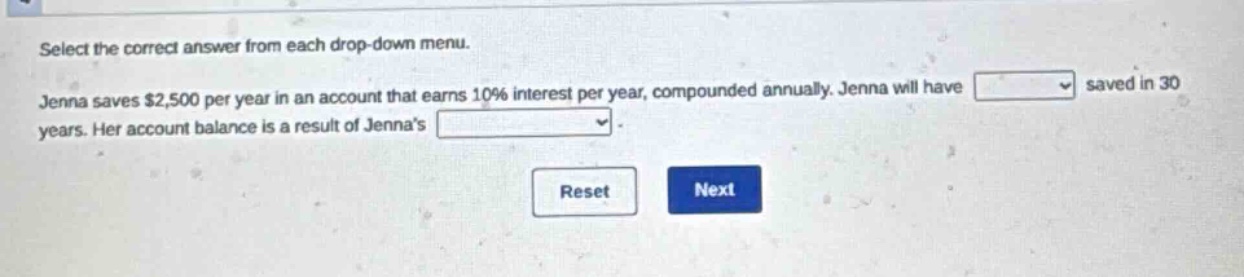
select the correct answer from each drop - down menu. jenna saves $2,500 per year in an account that earns 10% interest per year, compounded annually. jenna will have saved in 30 years. her account balance is a result of jennas
Answer
Explanation:
Step1: Identify the formula for future - value of an ordinary annuity
The formula for the future - value of an ordinary annuity is $F = A\times\frac{(1 + r)^{n}-1}{r}$, where $A$ is the annual payment, $r$ is the interest rate per period, and $n$ is the number of periods. Here, $A = 2500$, $r=0.1$, and $n = 30$.
Step2: Calculate $(1 + r)^{n}$
$(1 + 0.1)^{30}=17.44940227$.
Step3: Calculate $(1 + r)^{n}-1$
$17.44940227-1 = 16.44940227$.
Step4: Calculate $\frac{(1 + r)^{n}-1}{r}$
$\frac{16.44940227}{0.1}=164.4940227$.
Step5: Calculate the future - value $F$
$F=2500\times164.4940227 = 411235.05675\approx411235.06$.
The second part of the question is about the concept. The account balance is a result of Jenna's saving behavior and the power of compound interest.
Answer:
First drop - down: $$411235.06$ Second drop - down: Saving behavior and compound interest