select the correct answer.\nan entrepreneur estimates his total profit (total revenue minus total cost) for…
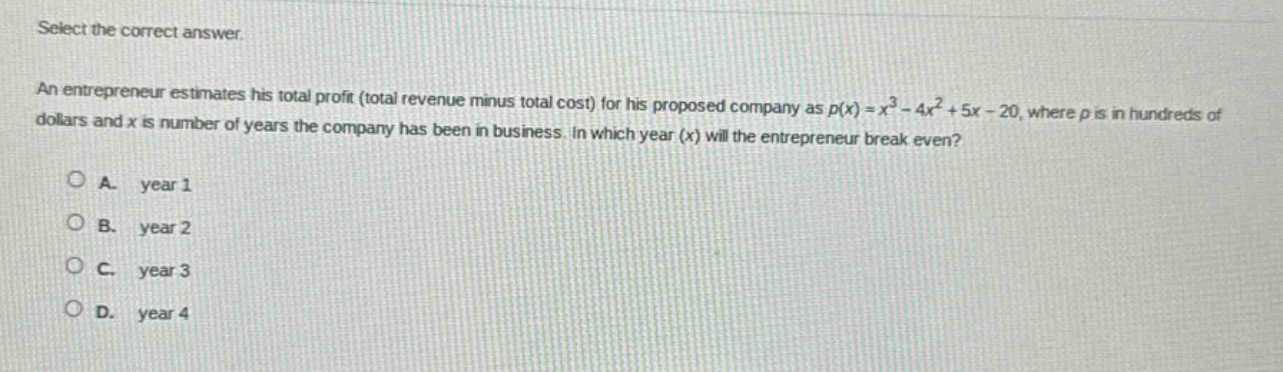
select the correct answer.\nan entrepreneur estimates his total profit (total revenue minus total cost) for his proposed company as $p(x)=x^{3}-4x^{2}+5x - 20$, where $p$ is in hundreds of dollars and $x$ is number of years the company has been in business. in which year ($x$) will the entrepreneur break even?\na. year 1\nb. year 2\nc. year 3\nd. year 4
Answer
Explanation:
Step1: Definir el criterio de equilibrio
El empresario alcanza el equilibrio cuando la ganancia $p(x) = 0$. Entonces, debemos resolver la ecuación $x^{3}-4x^{2}+5x - 20=0$.
Step2: Factorizar la ecuación
Agrupamos los términos: $(x^{3}-4x^{2})+(5x - 20)=0$. Sacamos factores comunes: $x^{2}(x - 4)+5(x - 4)=0$. Luego, $(x - 4)(x^{2}+5)=0$.
Step3: Resolver para $x$
Tenemos dos factores: $x - 4=0$ o $x^{2}+5=0$. La solución de $x - 4=0$ es $x = 4$. La solución de $x^{2}+5=0$ da $x^{2}=-5$, y no tiene soluciones reales.
Answer:
D. year 4