1. steamline bicycles produces two kinds of bikes, mountain bikes and road bikes. it takes 4 hours to build…
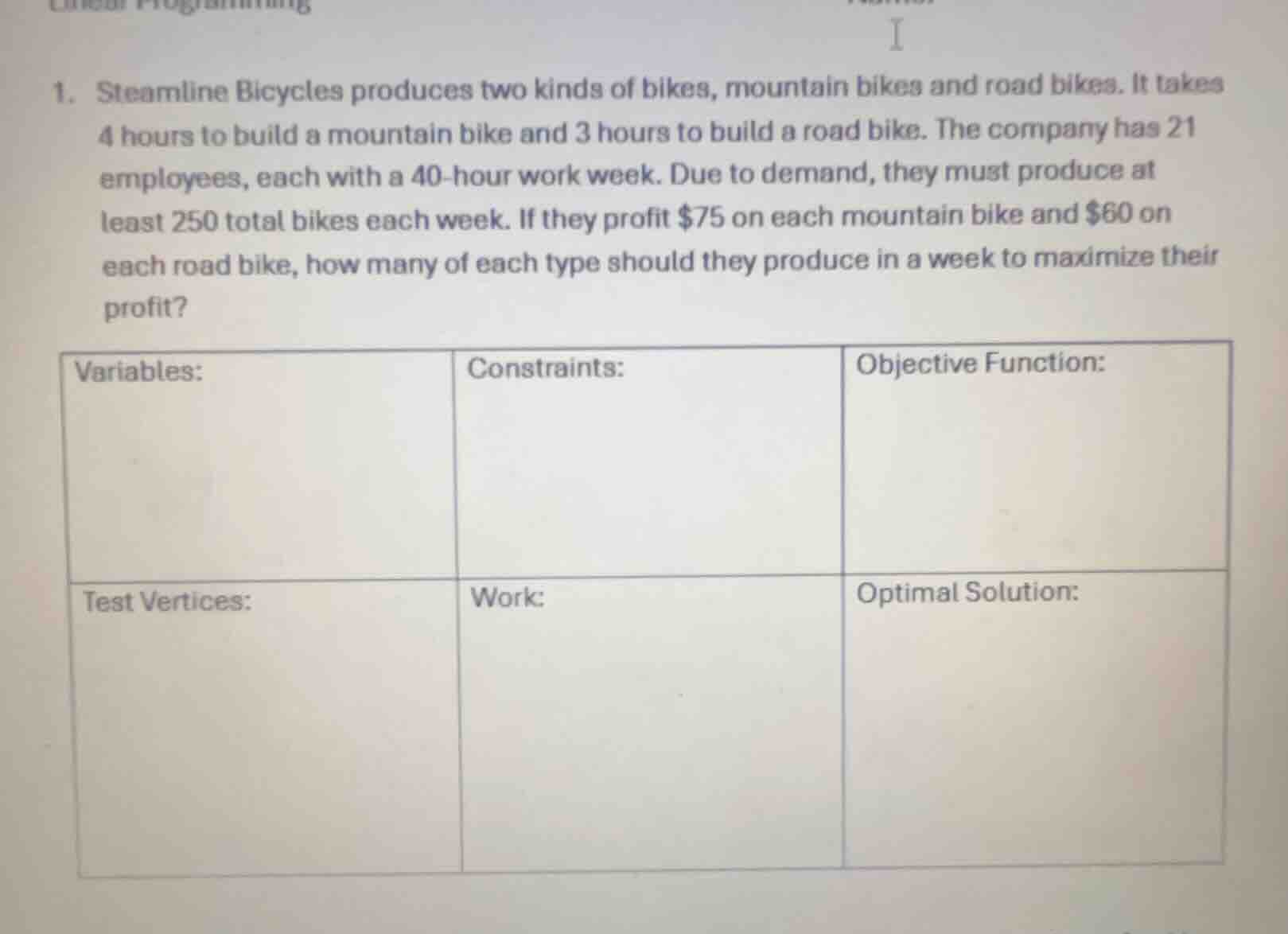
1. steamline bicycles produces two kinds of bikes, mountain bikes and road bikes. it takes 4 hours to build a mountain bike and 3 hours to build a road bike. the company has 21 employees, each with a 40 - hour work week. due to demand, they must produce at least 250 total bikes each week. if they profit $75 on each mountain bike and $60 on each road bike, how many of each type should they produce in a week to maximize their profit?\n| variables: | constraints: | objective function: |\n| --- | --- | --- |\n| test vertices: | work: | optimal solution: |
Answer
Variables:
Let ( x ) be the number of mountain bikes, ( y ) be the number of road bikes.
Constraints:
- Time Constraint: Total work hours available: ( 21 \times 40 = 840 ) hours. Time to build ( x ) mountain bikes and ( y ) road bikes: ( 4x + 3y \leq 840 ).
- Demand Constraint: Total bikes: ( x + y \geq 250 ).
- Non - negativity: ( x \geq 0, y \geq 0 ) (can't produce negative bikes).
Objective Function:
Profit ( P = 75x + 60y ) (maximize profit from mountain and road bikes).
Step 1: Find the feasible region boundaries
- From ( 4x + 3y = 840 ), when ( x = 0 ), ( y=\frac{840}{3}=280 ); when ( y = 0 ), ( x=\frac{840}{4}=210 ).
- From ( x + y=250 ), when ( x = 0 ), ( y = 250 ); when ( y = 0 ), ( x = 250 ).
Step 2: Find intersection of ( 4x + 3y = 840 ) and ( x + y=250 )
Solve the system:
From ( x + y=250 ), ( y = 250 - x ). Substitute into ( 4x + 3y = 840 ):
( 4x+3(250 - x)=840 )
( 4x + 750-3x=840 )
( x=840 - 750 = 90 )
Then ( y=250 - 90 = 160 ).
Test Vertices:
Feasible region vertices are found from constraint intersections:
- Intersection of ( x + y = 250 ) and ( y = 0 ): ( (250,0) )
- Intersection of ( 4x + 3y = 840 ) and ( x + y = 250 ): ( (90,160) )
- Intersection of ( 4x + 3y = 840 ) and ( x = 0 ): ( (0,280) ) (but check ( x + y\geq250 ), ( 0 + 280\geq250 ), valid)
Work: Calculate profit at each vertex
- At ( (250,0) ): ( P = 75(250)+60(0)=18750 )
- At ( (90,160) ): ( P = 75(90)+60(160)=6750 + 9600 = 16350 )
- At ( (0,280) ): ( P = 75(0)+60(280)=16800 )
Optimal Solution:
The maximum profit is at ( (250,0) )? Wait, no, wait: Wait, when ( x = 250 ), check time constraint: ( 4(250)+3y\leq840\Rightarrow1000 + 3y\leq840\Rightarrow3y\leq - 160 ), which is impossible. So ( (250,0) ) is not in the feasible region (violates time constraint).
Wait, mistake earlier: The feasible region is where ( 4x + 3y\leq840 ) and ( x + y\geq250 ), ( x,y\geq0 ).
So correct vertices:
- Intersection of ( x + y = 250 ) and ( 4x + 3y = 840 ): ( (90,160) ) (valid, ( 4(90)+3(160)=360 + 480 = 840 ), ( 90 + 160 = 250 ))
- Intersection of ( 4x + 3y = 840 ) and ( y = 0 ): ( (210,0) ) (since ( x + y\geq250 ), ( 210+0 = 210<250 ), invalid)
- Intersection of ( x + y = 250 ) and ( x = 0 ): ( (0,250) ) (check time: ( 4(0)+3(250)=750\leq840 ), valid)
- Intersection of ( 4x + 3y = 840 ) and ( x = 0 ): ( (0,280) ) (valid, ( 0 + 280\geq250 ))
Recalculate vertices correctly:
- ( (0,250) ): ( P = 75(0)+60(250)=15000 )
- ( (90,160) ): ( P = 75(90)+60(160)=6750 + 9600 = 16350 )
- ( (0,280) ): ( P = 60(280)=16800 )
- Wait, ( x + y\geq250 ), so when ( x = 0 ), ( y\geq250 ), and ( 4x + 3y\leq840\Rightarrow y\leq280 ). So ( y ) ranges from 250 to 280 when ( x = 0 ). But the vertex for maximum profit? Wait, no, the objective function ( P = 75x + 60y ). The coefficient of ( x ) (75) is higher than ( y ) (60), so we want to maximize ( x ) as much as possible, but subject to time.
Wait, let's re - solve the system properly.
Feasible region:
- ( x + y\geq250 )
- ( 4x + 3y\leq840 )
- ( x\geq0,y\geq0 )
The boundary lines:
( L1: x + y = 250 )
( L2: 4x + 3y = 840 )
The intersection of ( L1 ) and ( L2 ) is ( (90,160) ) (as before).
For ( x + y\geq250 ), the region is above ( L1 ); for ( 4x + 3y\leq840 ), below ( L2 ).
So the feasible region vertices are:
- ( (90,160) ) (intersection of ( L1 ) and ( L2 ))
- ( (0,280) ) (intersection of ( L2 ) and ( y )-axis, since ( 0 + 280\geq250 ))
- ( (0,250) ) (intersection of ( L1 ) and ( y )-axis)
- ( (250,0) ) is invalid (time constraint), ( (210,0) ) is invalid (demand constraint).
Now, calculate profit at each valid vertex:
- ( (0,250) ): ( P = 60\times250 = 15000 )
- ( (90,160) ): ( P = 75\times90+60\times160 = 6750 + 9600 = 16350 )
- ( (0,280) ): ( P = 60\times280 = 16800 )
Wait, but ( 75x + 60y ), when ( x = 0 ), ( y = 280 ), profit is 16800. When ( x = 90 ), ( y = 160 ), profit is 16350. When ( x = 0 ), ( y = 250 ), profit is 15000. But wait, is ( (0,280) ) valid? ( x + y=280\geq250 ), yes. Time: ( 3\times280 = 840 ), which is equal to total time (840), yes.
But wait, the mountain bike has higher profit per bike ($75 vs $60), but it takes more time (4 hours vs 3 hours). Let's check profit per hour: Mountain bike: ( \frac{75}{4}=18.75 ) per hour, Road bike: ( \frac{60}{3}=20 ) per hour. Oh! Road bikes have higher profit per hour. So we should maximize road bikes.
Ah, here's the mistake earlier: Profit per hour for mountain bike: ( 75/4 = 18.75 ), road bike: ( 60/3 = 20 ). So road bikes are more profitable per hour. So we should make as many road bikes as possible, then fill the remaining with mountain bikes (if needed).
Correct Feasible Region and Vertices
Total time: 840 hours. To maximize road bikes (since higher profit per hour), let's see:
If we make only road bikes: ( y=\frac{840}{3}=280 ), and ( x + y=280\geq250 ), so valid.
If we make only mountain bikes: ( x=\frac{840}{4}=210 ), but ( x + y=210<250 ), so we need to make at least 250 bikes. So the feasible region is where ( x + y\geq250 ), ( 4x + 3y\leq840 ), ( x,y\geq0 ).
Recalculate Profit with Correct Profit per Hour Insight
- At ( (0,280) ): ( P = 60\times280 = 16800 )
- At ( (90,160) ): ( P = 75\times90 + 60\times160 = 6750+9600 = 16350 )
- At ( (0,250) ): ( P = 60\times250 = 15000 )
- At ( (250 - y,x = 250 - y) )? No, better to use the two constraints.
Since road bikes have higher profit per hour, making 280 road bikes (and 0 mountain bikes) gives profit 16800, which is higher than making 90 mountain and 160 road (16350) or 250 road and 0 mountain (but 250 road bikes take ( 3\times250 = 750 ) hours, leaving ( 840 - 750 = 90 ) hours, which could be used for mountain bikes: ( x=\frac{90}{4}=22.5 ), but we can't make half bikes. Wait, no, the problem says "how many of each type", so we assume integer values? Wait, the problem doesn't specify integer bikes, so we can use real numbers.
But wait, the intersection of ( x + y = 250 ) and ( 4x + 3y = 840 ) is ( (90,160) ), which is integer. Let's check the time for ( (90,160) ): ( 4(90)+3(160)=360 + 480 = 840 ) (exact time), and ( 90 + 160 = 250 ) (exact demand).
Final Check of Profit
- ( (0,280) ): ( P = 60\times280 = 16800 )
- ( (90,160) ): ( P = 75\times90 + 60\times160 = 6750 + 9600 = 16350 )
- ( (250,0) ): Invalid (time: ( 4\times250 = 1000>840 ))
- ( (0,250) ): ( P = 15000 ), time: ( 3\times250 = 750\leq840 ), but we can make more road bikes (up to 280) since time allows.
So the optimal solution is to produce 0 mountain bikes and 280 road bikes? Wait, but the demand is at least 250 total bikes, and 280 is more than 250, so it's valid. But wait, let's check the profit per hour again: road bike is $20 per hour, mountain bike is $18.75 per hour. So road bikes are better, so we should make as many road bikes as possible (280), which uses all 840 hours, and meets the demand (280 ≥ 250).
But wait, the initial mistake was in the vertex for ( x + y = 250 ) and ( x = 0 ): ( (0,250) ), but we can make more road bikes (up to 280) because time allows (3*280=840 ≤ 840). So the feasible region includes all points where ( x + y ≥ 250 ), ( 4x + 3y ≤ 840 ), ( x,y ≥ 0 ). So the vertex with maximum profit is where we use all time on road bikes (since they are more profitable per hour), giving ( (0,280) ), profit $16,800.
Wait, but let's confirm with the objective function: ( P = 75x + 60y = 15(5x + 4y) ). To maximize ( 5x + 4y ) under ( 4x + 3y ≤ 840 ), ( x + y ≥ 250 ), ( x,y ≥ 0 ).
Let ( z = 5x + 4y ). From ( x + y = 250 ), ( x = 250 - y ). Substitute into ( z ): ( z = 5(250 - y)+4y = 1250 - y ). To maximize ( z ), minimize ( y ). The minimum ( y ) is 250 (from ( x + y = 250 ) and ( x ≥ 0 )), so ( z = 1250 - 250 = 1000 ), ( P = 15×1000 = 15000 ).
From ( 4x + 3y = 840 ), ( x=\frac{840 - 3y}{4} ). Substitute into ( z ): ( z = 5(\frac{840 - 3y}{4})+4y=\frac{4200 - 15y}{4}+4y=\frac{4200 - 15y + 16y}{4}=\frac{4200 + y}{4} ). To maximize ( z ), maximize ( y ). The maximum ( y ) is 280 (from ( 4x + 3y = 840 ) and ( x ≥ 0 )), so ( z=\frac{4200 + 280}{4}=\frac{4480}{4}=1120 ), ( P = 15×1120 = 16800 ).
Ah, so using the second method, when we maximize ( y ) (road bikes) in the time constraint, we get a higher ( z ) (and thus higher profit). So the key was realizing that road bikes have a higher profit per hour, so we should make as many road bikes as possible (280), using all 840 hours, which satisfies the demand (280 ≥ 250).
Correct Optimal Solution
Produce 0 mountain bikes and 280 road bikes to maximize profit at $16,800.
But wait, let's check the intersection of the two constraints again. The two lines ( 4x + 3y = 840 ) and ( x + y = 250 ) intersect at (90,160). But since road bikes are more profitable per hour, we should move along the time constraint line ( 4x + 3y = 840 ) towards increasing ( y ) (road bikes) and decreasing ( x ) (mountain bikes), because each road bike we make instead of a mountain bike gives us more profit per hour.
So from (90,160), if we make one less mountain bike (x=89), we free up 4 hours, which can make (