suppose that $4000 is placed in an account that pays 3% interest compounded each year. assume that no…
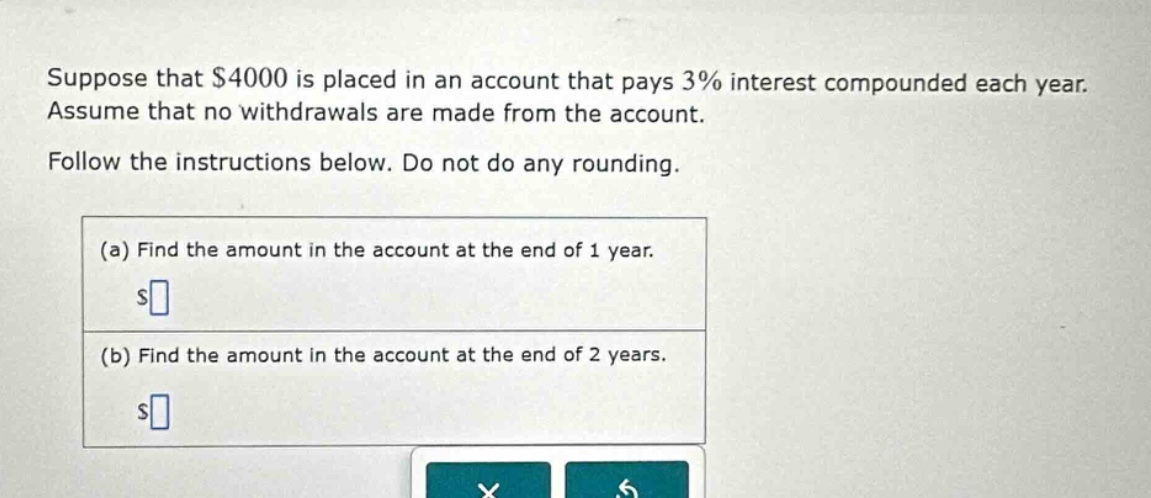
suppose that $4000 is placed in an account that pays 3% interest compounded each year. assume that no withdrawals are made from the account. follow the instructions below. do not do any rounding. (a) find the amount in the account at the end of 1 year. $ (b) find the amount in the account at the end of 2 years. $
Answer
Explanation:
Step1: Recall compound - interest formula
The compound - interest formula is $A = P(1 + r)^t$, where $P$ is the principal amount, $r$ is the annual interest rate (in decimal form), and $t$ is the number of years. Here, $P=$4000$, $r = 0.03$ (since $3%=0.03$).
Step2: Calculate amount after 1 year
For $t = 1$, substitute $P = 4000$, $r=0.03$, and $t = 1$ into the formula $A = P(1 + r)^t$. $A_1=4000\times(1 + 0.03)^1=4000\times1.03 = 4120$
Step3: Calculate amount after 2 years
For $t = 2$, substitute $P = 4000$, $r = 0.03$, and $t = 2$ into the formula $A = P(1 + r)^t$. $A_2=4000\times(1 + 0.03)^2=4000\times(1.03)^2=4000\times1.0609 = 4243.6$
Answer:
(a) $4120$ (b) $4243.6$