suppose you have $16,000 to invest in three stocks, a, b, and c. stock a is a low - risk stock that has…
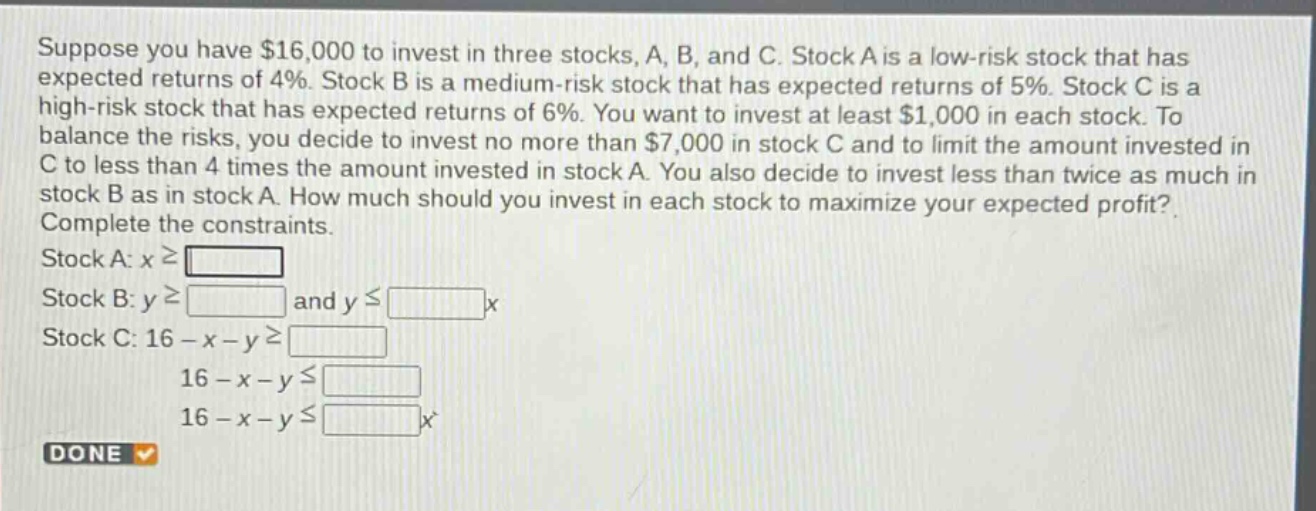
suppose you have $16,000 to invest in three stocks, a, b, and c. stock a is a low - risk stock that has expected returns of 4%. stock b is a medium - risk stock that has expected returns of 5%. stock c is a high - risk stock that has expected returns of 6%. you want to invest at least $1,000 in each stock. to balance the risks, you decide to invest no more than $7,000 in stock c and to limit the amount invested in c to less than 4 times the amount invested in stock a. you also decide to invest less than twice as much in stock b as in stock a. how much should you invest in each stock to maximize your expected profit? complete the constraints. stock a: $xgeqsquare$ stock b: $ygeqsquare$ and $yleqsquare x$ stock c: $16 - x - ygeqsquare$ $16 - x - yleqsquare$ $16 - x - yleqsquare x$ done
Answer
Answer:
Stock A: $x\geq1000$ Stock B: $y\geq1000$ and $y\leq2x$ Stock C: $16000 - x - y\geq1000$ $16000 - x - y\leq7000$ $16000 - x - y\leq4x$
Explanation:
Step1: Interpret investment - minimum
Since you want to invest at least $1000$ in each stock, for stock A, $x\geq1000$, for stock B, $y\geq1000$.
Step2: Interpret B - to - A ratio
You decide to invest less than twice as much in stock B as in stock A, so $y\leq2x$.
Step3: Interpret C - minimum
The amount invested in stock C is $16000 - x - y$, and since at least $1000$ should be invested in stock C, $16000 - x - y\geq1000$.
Step4: Interpret C - maximum
You decide to invest no more than $7000$ in stock C, so $16000 - x - y\leq7000$.
Step5: Interpret C - to - A ratio
You limit the amount invested in C to less than 4 times the amount invested in stock A, so $16000 - x - y\leq4x$.