the table compares two countries and two products. what might be the best decision for country a? focus both…
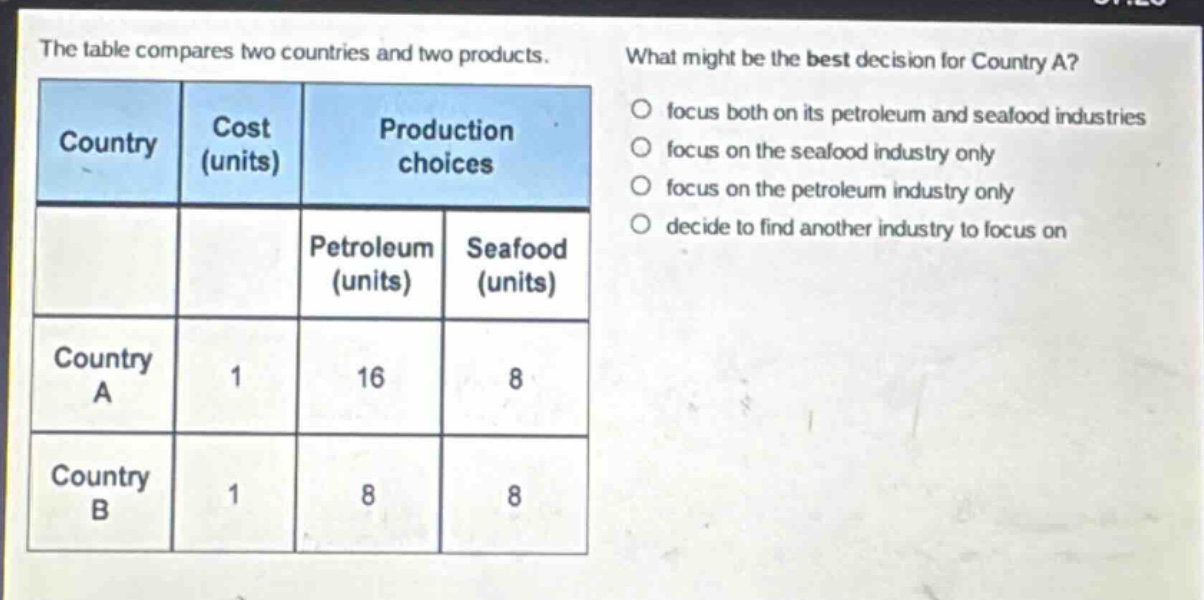
the table compares two countries and two products. what might be the best decision for country a? focus both on its petroleum and seafood industries focus on the seafood industry only focus on the petroleum industry only decide to find another industry to focus on\n\n| country | cost (units) | production choices | | | petroleum (units) | seafood (units) | | country a | 1 | 16 | 8 | | country b | 1 | 8 | 8 |
Answer
Explanation:
Step1: Calculate opportunity - cost
For Country A, the opportunity - cost of producing 1 unit of petroleum is $\frac{8}{16}=0.5$ units of seafood. For Country B, the opportunity - cost of producing 1 unit of petroleum is $\frac{8}{8} = 1$ unit of seafood. Since Country A has a lower opportunity - cost in producing petroleum (0.5 < 1), it has a comparative advantage in petroleum production.
Answer:
focus on the petroleum industry only