the table shows the value of an account x years after the account was opened.\naccount value over time\n|…
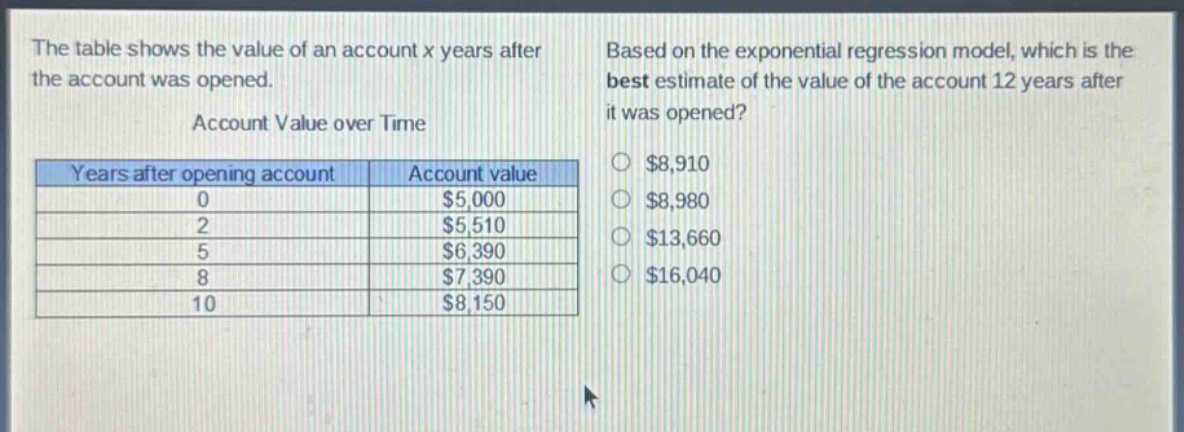
the table shows the value of an account x years after the account was opened.\naccount value over time\n| years after opening account | account value |\n| ---- | ---- |\n| 0 | $5,000 |\n| 2 | $5,510 |\n| 5 | $6,390 |\n| 8 | $7,390 |\n| 10 | $8,150 |\nbased on the exponential regression model, which is the best estimate of the value of the account 12 years after it was opened?\n$8,910\n$8,980\n$13,660\n$16,040
Answer
Explanation:
Step1: Assume exponential regression model
The general form of an exponential regression model is $y = ab^x$, where $y$ is the account - value, $x$ is the number of years after opening the account, $a$ is the initial value, and $b$ is the growth factor. When $x = 0$, $y=a$. From the table, when $x = 0$, $y = 5000$, so $a = 5000$.
Step2: Find the growth factor $b$ using another data - point
Let's use the point $(2,5510)$. Substitute $a = 5000$, $x = 2$, and $y = 5510$ into $y=ab^x$. We get $5510=5000b^2$. Then $b^2=\frac{5510}{5000}=1.102$, and $b=\sqrt{1.102}\approx1.05$.
Step3: Predict the value at $x = 12$
Substitute $a = 5000$, $b\approx1.05$, and $x = 12$ into $y = ab^x$. So $y=5000\times(1.05)^{12}$. Using the formula for exponentiation, $(1.05)^{12}\approx1.795856$. Then $y = 5000\times1.795856\approx8979.28\approx8980$.
Answer:
$8,980$