the table shows the value of a savings bond that doubles in value after 5 years.\nsavings bond value\n| time…
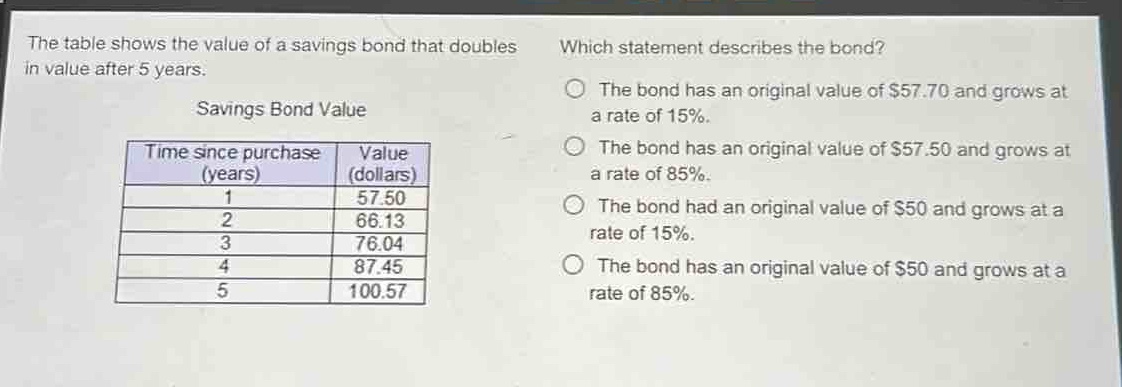
the table shows the value of a savings bond that doubles in value after 5 years.\nsavings bond value\n| time since purchase (years) | value (dollars) |\n| ---- | ---- |\n| 1 | 57.50 |\n| 2 | 66.13 |\n| 3 | 76.04 |\n| 4 | 87.45 |\n| 5 | 100.57 |\nwhich statement describes the bond?\nthe bond has an original value of $57.70 and grows at a rate of 15%.\nthe bond has an original value of $57.50 and grows at a rate of 85%.\nthe bond had an original value of $50 and grows at a rate of 15%.\nthe bond has an original value of $50 and grows at a rate of 85%.
Answer
Explanation:
Step1: Recall compound - interest formula
The compound - interest formula is $A = P(1 + r)^t$, where $A$ is the final amount, $P$ is the principal (original) amount, $r$ is the annual interest rate, and $t$ is the number of years.
Step2: Test the value of $P$ and $r$ for $t = 1$
Let's start by checking the first row of the table where $t = 1$ and $A=57.50$. If we assume $P = 50$ and $r=0.15$ (or 15%), then $A=P(1 + r)^t=50(1 + 0.15)^1=50\times1.15 = 57.50$.
Step3: Check for other values of $t$
For $t = 2$, $A = P(1 + r)^t=50(1 + 0.15)^2=50\times1.15^2=50\times1.3225 = 66.125\approx66.13$. For $t = 3$, $A = P(1 + r)^t=50(1 + 0.15)^3=50\times1.15^3=50\times1.520875 = 76.04375\approx76.04$. For $t = 4$, $A = P(1 + r)^t=50(1 + 0.15)^4=50\times1.15^4=50\times1.74900625 = 87.4503125\approx87.45$. For $t = 5$, $A = P(1 + r)^t=50(1 + 0.15)^5=50\times1.15^5=50\times2.0113571875 = 100.567859375\approx100.57$.
Answer:
The bond had an original value of $50 and grows at a rate of 15%.