texas economics\n17. what are some reasons texas transformed to a mostly urban society from a mostly…
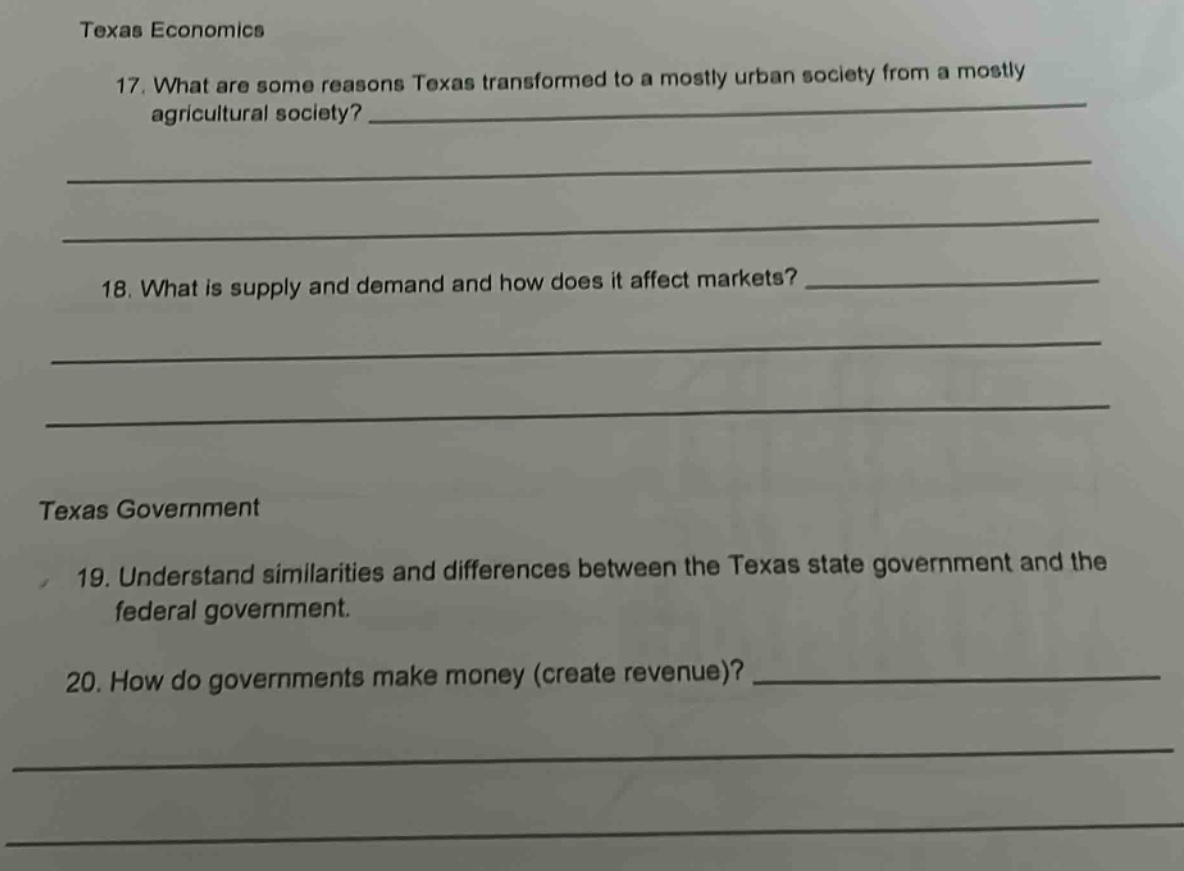
texas economics\n17. what are some reasons texas transformed to a mostly urban society from a mostly agricultural society?\n\n\n\n\n18. what is supply and demand and how does it affect markets?\n\n\n\n\ntexas government\n19. understand similarities and differences between the texas state government and the federal government.\n20. how do governments make money (create revenue)?
Answer
Brief Explanations:
- Industrialization led to job - creation in urban areas, attracting people from rural agricultural areas. Technological advancements in agriculture reduced the need for a large rural workforce. Urban areas offered better amenities and services.
- Supply is the quantity of a good or service that producers are willing to offer at various prices, and demand is the quantity that consumers are willing to buy at various prices. When supply exceeds demand, prices tend to fall; when demand exceeds supply, prices rise. This affects market equilibrium, production levels, and resource allocation.
- Similarities: Both have legislative, executive, and judicial branches for separation of powers. Differences: The federal government has broader jurisdiction over national issues, while the Texas state government focuses on state - specific matters. The Texas Constitution may have different provisions compared to the U.S. Constitution.
- Governments make money through taxes (income, sales, property, etc.), fees for services (such as licensing fees), and sometimes through borrowing or selling government - owned assets.
Answer:
- Industrialization, agricultural tech advancements, urban amenities.
- Supply is producer - offered quantity, demand is consumer - desired quantity. Affects prices, equilibrium, production.
- Similar: Separation of powers. Different: Jurisdiction scope, constitutional provisions.
- Taxes, fees for services, borrowing/selling assets.