a. use the appropriate formula to determine the periodic deposit. b. how much of the financial goal comes…
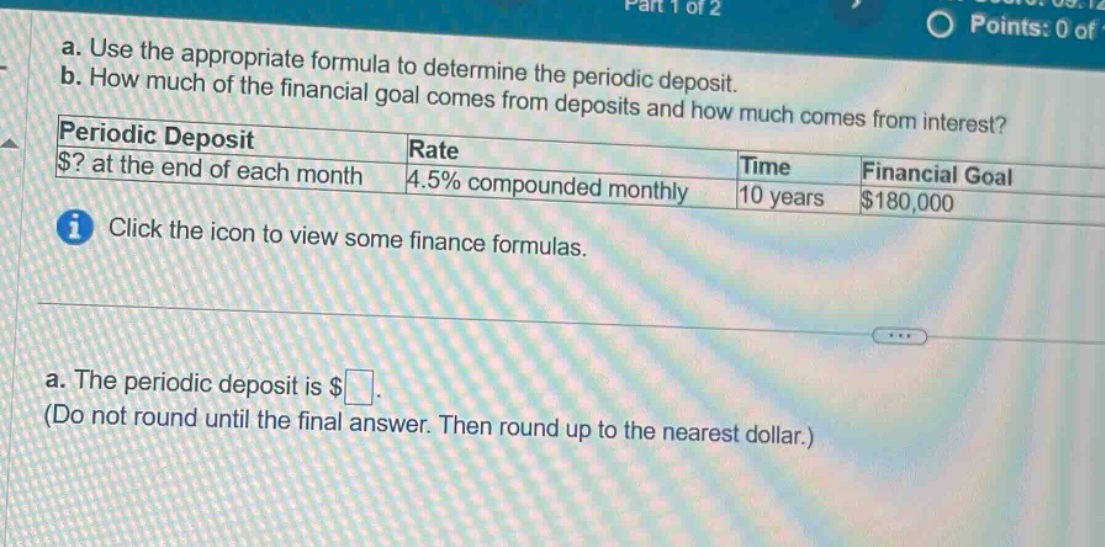
a. use the appropriate formula to determine the periodic deposit. b. how much of the financial goal comes from deposits and how much comes from interest? periodic deposit rate time financial goal $? at the end of each month 4.5% compounded monthly 10 years $180,000 click the icon to view some finance formulas. a. the periodic deposit is $. (do not round until the final answer. then round up to the nearest dollar.)
Answer
Explanation:
Step1: Identify the relevant formula
The formula for the future - value of an ordinary annuity is $F = P\times\frac{(1 + \frac{r}{n})^{nt}-1}{\frac{r}{n}}$, where $F$ is the future value of the annuity, $P$ is the periodic payment, $r$ is the annual interest rate (in decimal form), $n$ is the number of times compounded per year, and $t$ is the number of years. We are given that $F=$180000$, $r = 0.045$ (since $4.5%=0.045$), $n = 12$ (compounded monthly), and $t = 10$ years. We need to solve for $P$.
Step2: Rearrange the formula for $P$
Starting with $F = P\times\frac{(1+\frac{r}{n})^{nt}-1}{\frac{r}{n}}$, we can solve for $P$ as $P=\frac{F\times\frac{r}{n}}{(1 + \frac{r}{n})^{nt}-1}$.
Step3: Substitute the values
Substitute $F = 180000$, $r=0.045$, $n = 12$, and $t = 10$ into the formula for $P$. First, calculate $(1+\frac{r}{n})^{nt}=(1+\frac{0.045}{12})^{12\times10}=(1 + 0.00375)^{120}$. Using a calculator, $(1 + 0.00375)^{120}\approx1.565681$. Then, $\frac{r}{n}=\frac{0.045}{12}=0.00375$. $P=\frac{180000\times0.00375}{1.565681 - 1}=\frac{675}{0.565681}\approx1193.25$.
Step4: Round the result
Rounding up to the nearest dollar, $P = 1194$.
Answer:
$1194$