the value of a computer depreciates with age, as shown in the table.\nvalue of a computer\n| age of computer…
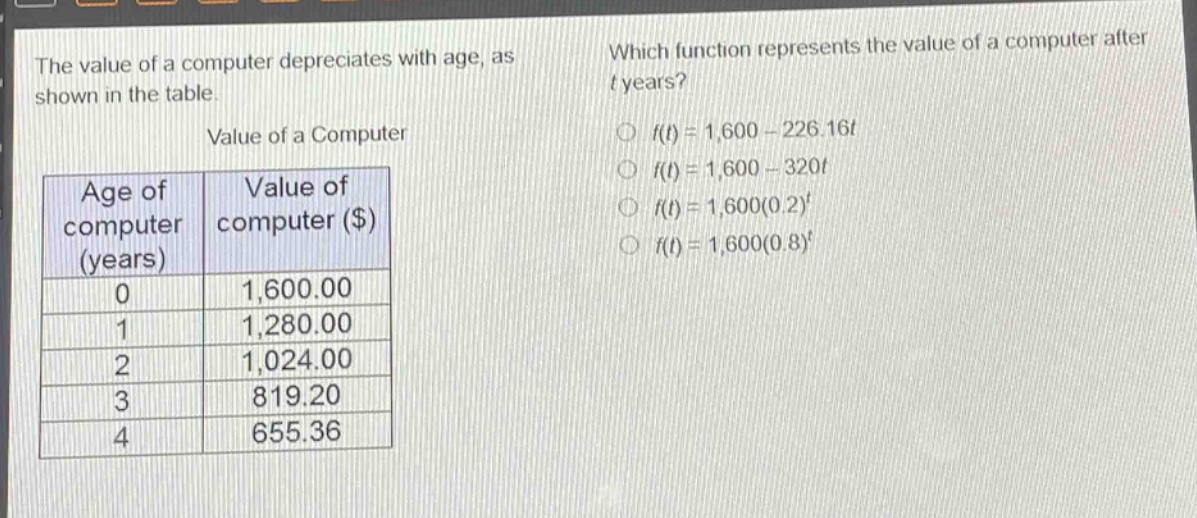
the value of a computer depreciates with age, as shown in the table.\nvalue of a computer\n| age of computer (years) | value of computer ($) |\n| ---- | ---- |\n| 0 | 1,600.00 |\n| 1 | 1,280.00 |\n| 2 | 1,024.00 |\n| 3 | 819.20 |\n| 4 | 655.36 |\nwhich function represents the value of a computer after t years?\n○ (f(t)=1,600 - 226.16t)\n○ (f(t)=1,600 - 320t)\n○ (f(t)=1,600(0.2)^t)\n○ (f(t)=1,600(0.8)^t)
Answer
Answer:
D. $f(t)=1600(0.8)^t$
Explanation:
Step1: Check linear - decay form
For a linear - decay function $y = a+bt$, when $t = 0$, $y=a$. For the first two functions $f(t)=1600 - 226.16t$ and $f(t)=1600 - 320t$, when $t = 0$, $f(0)=1600$. But when $t = 1$, for $f(t)=1600 - 226.16t$, $f(1)=1600-226.16 = 1373.84$; for $f(t)=1600 - 320t$, $f(1)=1600 - 320=1280$. The rate of change in a linear function is constant. However, if we calculate the differences between consecutive values in the table, the differences are not constant, so it's not a linear - decay function.
Step2: Check exponential - decay form
The general form of an exponential - decay function is $y = a\cdot r^t$, where $a$ is the initial value and $r$ is the decay factor with $0<r<1$. When $t = 0$, for $f(t)=1600(0.2)^t$, $f(0)=1600(0.2)^0=1600$, and for $f(t)=1600(0.8)^t$, $f(0)=1600(0.8)^0 = 1600$. When $t = 1$, for $f(t)=1600(0.2)^t$, $f(1)=1600\times0.2=320$; for $f(t)=1600(0.8)^t$, $f(1)=1600\times0.8 = 1280$. When $t = 2$, $f(2)=1600\times(0.8)^2=1600\times0.64 = 1024$. When $t = 3$, $f(3)=1600\times(0.8)^3=1600\times0.512 = 819.2$. When $t = 4$, $f(4)=1600\times(0.8)^4=1600\times0.4096 = 655.36$. These values match the values in the table. So the function is $f(t)=1600(0.8)^t$.