what is an assumption historians make when they evaluate a source of information?\nthey know an eyewitness…
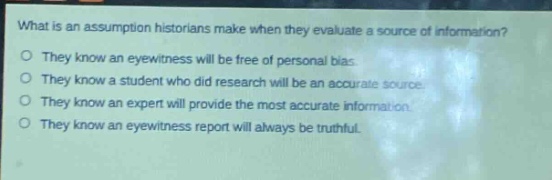
what is an assumption historians make when they evaluate a source of information?\nthey know an eyewitness will be free of personal bias.\nthey know a student who did research will be an accurate source.\nthey know an expert will provide the most accurate information.\nthey know an eyewitness report will always be truthful.
Answer
Answer:
None of the above options are correct assumptions. However, if we had to choose the least - wrong one among them, it could be argued that "They know an expert will provide the most accurate information." is a common (though not always correct) assumption. But in reality, historians do not assume any of these things blindly. Eyewitnesses can have biases, student - researchers may make errors, and eyewitness reports may be inaccurate due to memory issues etc.
Brief Explanations:
Historians critically evaluate sources. Eyewitnesses can be influenced by personal biases. Student - researchers may lack experience or make mistakes. Experts can also be wrong or have their own agendas. Eyewitness reports are not always truthful due to factors like memory distortion.