in \civil disobedience,\ what is thoreaus view of the state at the end of the essay?\nhe thinks the state…
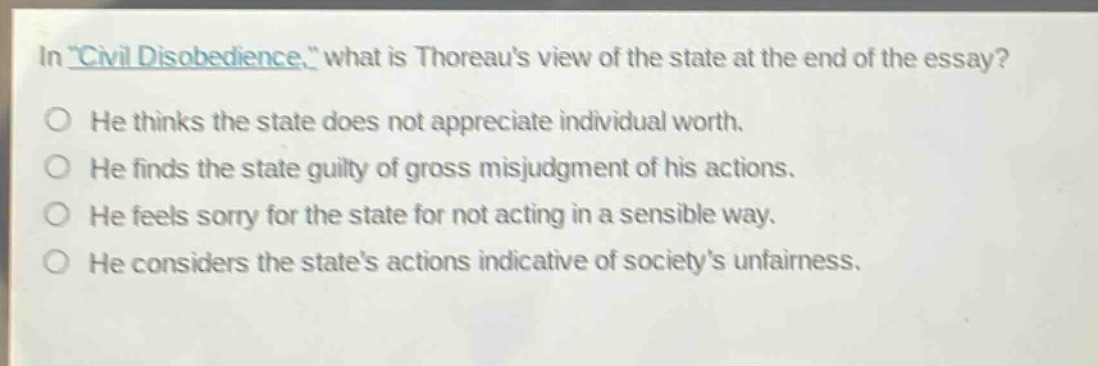
in \civil disobedience,\ what is thoreaus view of the state at the end of the essay?\nhe thinks the state does not appreciate individual worth.\nhe finds the state guilty of gross misjudgment of his actions.\nhe feels sorry for the state for not acting in a sensible way.\nhe considers the states actions indicative of societys unfairness.
Answer
Brief Explanations:
Thoreau in "Civil Disobedience" critiques the state's actions. He doesn't mainly focus on the state not appreciating individual worth (the essay is more about unjust actions). He isn't just about the state misjudging his actions (it's a broader critique). And while he critiques the state, the key is that he feels sorry for the state's lack of sensible action as it fails to fulfill its proper role. Considering the state's actions as indicative of society's unfairness is more of a general implication but not the direct view at the end focused on the state's own non - sensible behavior.
Answer:
He feels sorry for the state for not acting in a sensible way.