question\nwould you ever try to revolutionize the way the country works or lives? why or why not?\nhow might…
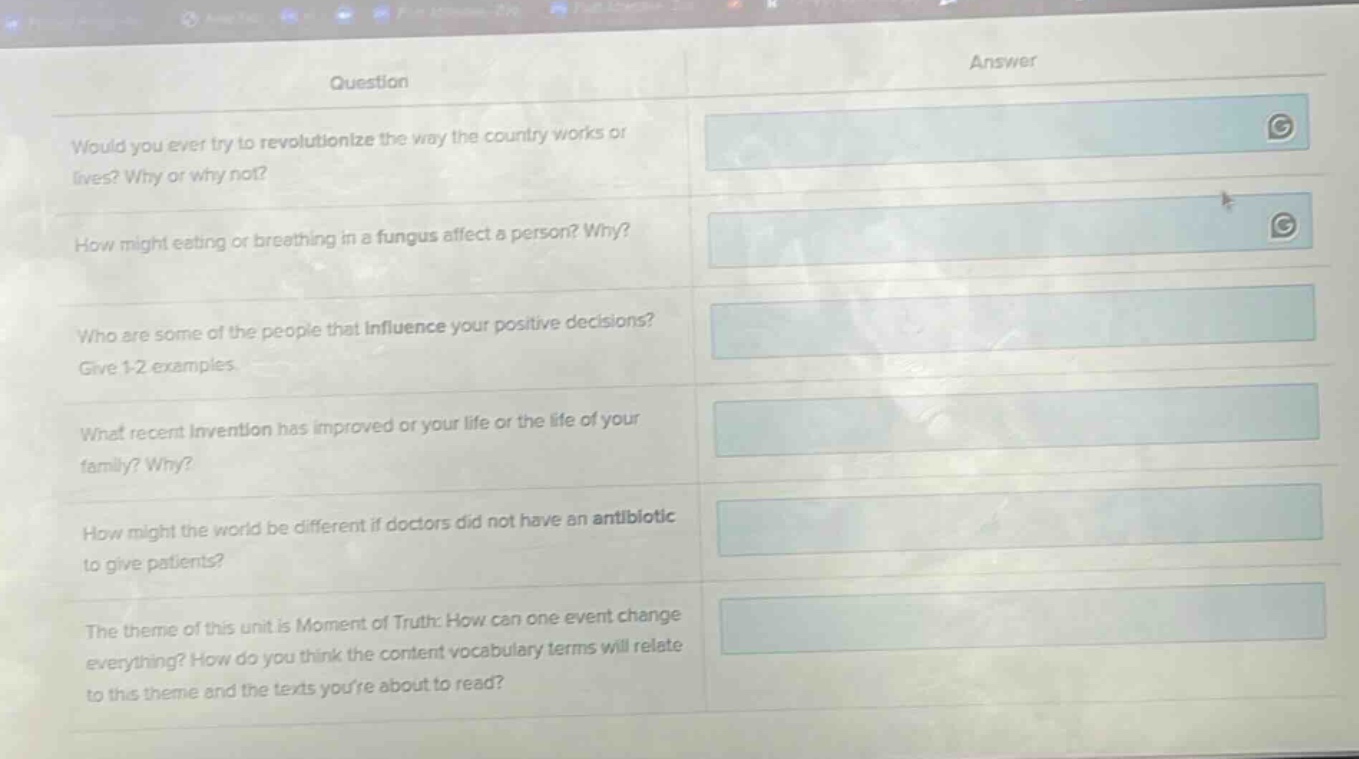
question\nwould you ever try to revolutionize the way the country works or lives? why or why not?\nhow might eating or breathing in a fungus affect a person? why?\nwho are some of the people that influence your positive decisions? give 1 - 2 examples.\nwhat recent invention has improved or your life or the life of your family? why?\nhow might the world be different if doctors did not have an antibiotic to give patients?\nthe theme of this unit is moment of truth: how can one event change everything? how do you think the content vocabulary terms will relate to this theme and the texts youre about to read?
Answer
- Question: Would you ever try to revolutionize the way the country works or lives? Why or why not?
- Brief Explanations: This question pertains to one's stance on social - political change. It involves considering personal values, beliefs about the country's current state, and the potential for large - scale transformation.
- Answer: Responses may vary. Some may say yes, citing issues like inequality or inefficiency and a desire for a better society. Others may say no, due to concerns about stability or the belief that change should be incremental.
- Question: How might eating or breathing in a fungus affect a person? Why?
- Brief Explanations: This is a question related to the field of biology and medicine. Fungi can cause various health effects depending on the type and the route of exposure.
- Answer: Eating a toxic fungus can lead to food poisoning, with symptoms like nausea, vomiting, and diarrhea. Breathing in fungal spores can cause respiratory problems such as allergic reactions, asthma attacks, or in severe cases, fungal infections in the lungs, because the body's immune system reacts to the foreign substances.
- Question: Who are some of the people that influence your positive decisions? Give 1 - 2 examples.
- Brief Explanations: This question delves into personal relationships and the impact of others on one's decision - making process, which is related to psychology and social science.
- Answer: Examples could include parents, who provide guidance and support based on their life experiences; or teachers, who offer knowledge and advice that can shape one's perspective and choices.
- Question: What recent invention has improved your life or the life of your family? Why?
- Brief Explanations: This question is about the impact of technology on daily life, which can be related to natural science (specifically engineering and computer science) and its applications.
- Answer: For example, smartphones have improved lives by providing easy access to communication, information, and various services. They allow for quick connection with family and friends, access to news and educational resources, and the ability to perform tasks like online shopping and banking on - the - go.
- Question: How might the world be different if doctors did not have an antibiotic to give patients?
- Brief Explanations: This question is related to medicine and health. Antibiotics play a crucial role in treating bacterial infections, and their absence would have far - reaching consequences.
- Answer: Without antibiotics, common bacterial infections could become life - threatening. Minor surgeries could be extremely risky due to the high likelihood of post - operative infections. There would be a higher mortality rate, especially among vulnerable populations like children, the elderly, and those with weakened immune systems.
- Question: The theme of this unit is Moment of Truth: How can one event change everything? How do you think the content vocabulary terms will relate to this theme and the texts you're about to read?
- Brief Explanations: This question is about analyzing the relationship between a theme, vocabulary, and text content, which is related to language arts and literary analysis.
- Answer: The vocabulary terms may describe the events, emotions, or concepts associated with the "moment of truth." They could be used to explain how an event unfolds, the impact it has, or the reactions of the characters. By understanding these terms, one can better understand the connection between the event and the overall change it brings about in the story or real - life situation presented in the texts.