read the dictionary entry.\nharrow (n): farm implement; (v): to inflict great stress on\nwhich sentence uses…
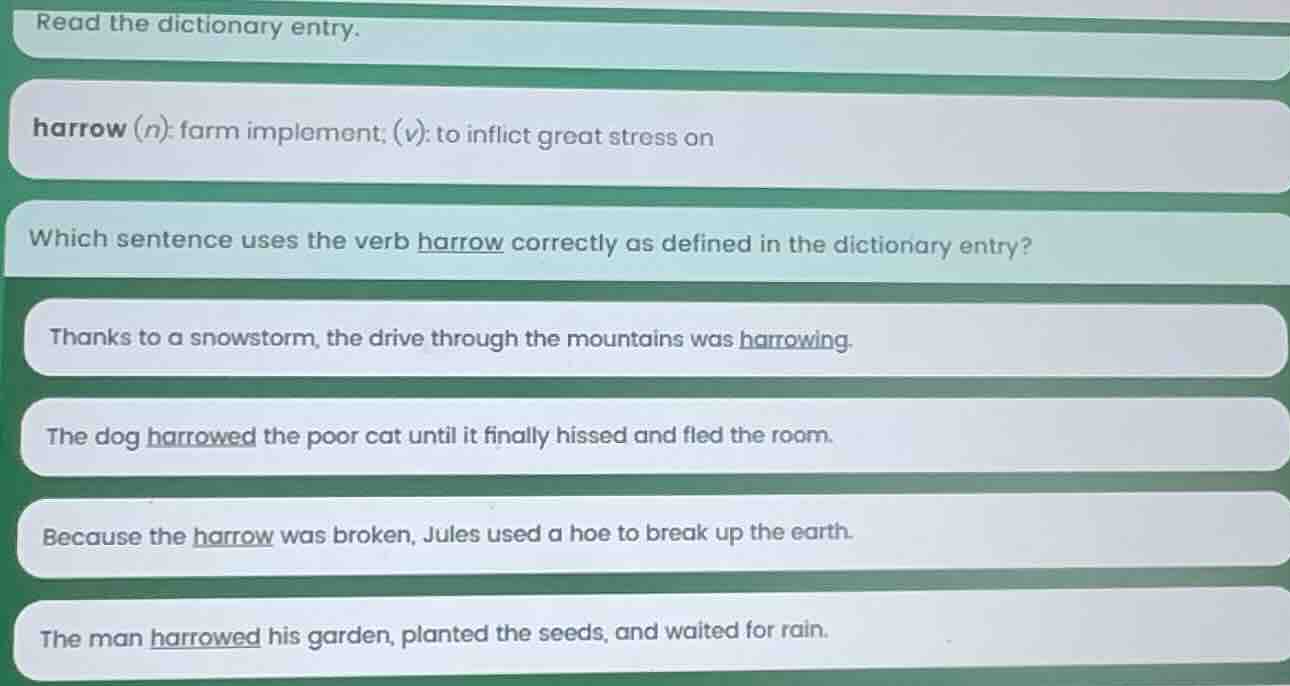
read the dictionary entry.\nharrow (n): farm implement; (v): to inflict great stress on\nwhich sentence uses the verb harrow correctly as defined in the dictionary entry?\nthanks to a snowstorm, the drive through the mountains was harrowing.\nthe dog harrowed the poor cat until it finally hissed and fled the room.\nbecause the harrow was broken, jules used a hoe to break up the earth.\nthe man harrowed his garden, planted the seeds, and waited for rain.
Answer
Brief Explanations:
- Analyze the verb definition of "harrow": to inflict great stress on.
- Check each option:
- First option: "harrowing" is an adjective (from the verb "harrow"), but the sentence describes the drive as causing stress? No, "harrowing" means extremely worrying or disturbing, but the verb form here is not used as "to inflict stress" in the action sense. Wait, no, let's re - check. The first option uses "harrowing" (adjective), not the verb "harrow" in action.
- Second option: The dog's action of bothering the cat until it hissed and fled can be seen as inflicting stress on the cat, which matches the verb definition of "harrow" (to inflict great stress on).
- Third option: Uses "harrow" as a noun (farm implement), not the verb.
- Fourth option: Uses "harrow" as a verb but in the sense of a farm implement's action (breaking up earth), which is the noun's related action, not the "inflict stress" verb definition.
Answer:
The dog harrowed the poor cat until it finally hissed and fled the room.