read the passage.\nin no other department is a thorough knowledge of history so important as in philosophy…
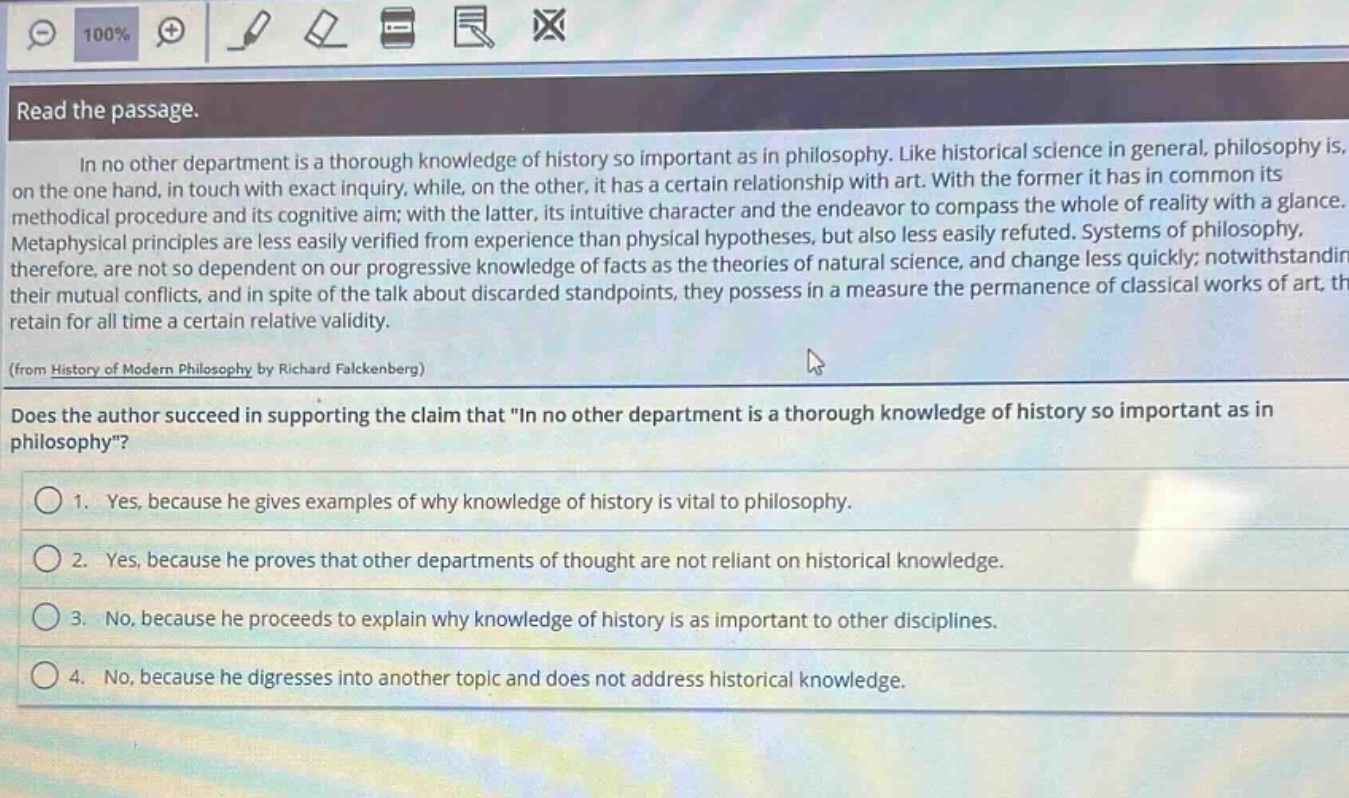
read the passage.\nin no other department is a thorough knowledge of history so important as in philosophy. like historical science in general, philosophy is, on the one hand, in touch with exact inquiry, while, on the other, it has a certain relationship with art. with the former it has in common its methodical procedure and its cognitive aim; with the latter, its intuitive character and the endeavor to compass the whole of reality with a glance. metaphysical principles are less easily verified from experience than physical hypotheses, but also less easily refuted. systems of philosophy, therefore, are not so dependent on our progressive knowledge of facts as the theories of natural science, and change less quickly; notwithstanding their mutual conflicts, and in spite of the talk about discarded standpoints, they possess in a measure the permanence of classical works of art, they retain for all time a certain relative validity.\n(from history of modern philosophy by richard falckenberg)\ndoes the author succeed in supporting the claim that \in no other department is a thorough knowledge of history so important as in philosophy\?\n1. yes, because he gives examples of why knowledge of history is vital to philosophy.\n2. yes, because he proves that other departments of thought are not reliant on historical knowledge.\n3. no, because he proceeds to explain why knowledge of history is as important to other disciplines.\n4. no, because he digresses into another topic and does not address historical knowledge.
Answer
Brief Explanations:
The author compares philosophy's relationship with history to its relations with exact - inquiry and art, and also contrasts philosophical systems with natural - science theories in terms of reliance on historical knowledge. He gives examples like the methodical and cognitive aspects related to exact inquiry and the intuitive and comprehensive aspects related to art, which show why history is vital to philosophy.
Answer:
- Yes, because he gives examples of why knowledge of history is vital to philosophy.