read the sentence. unfazed by the morning frenzy before school, dad gave us our lunches before we left…
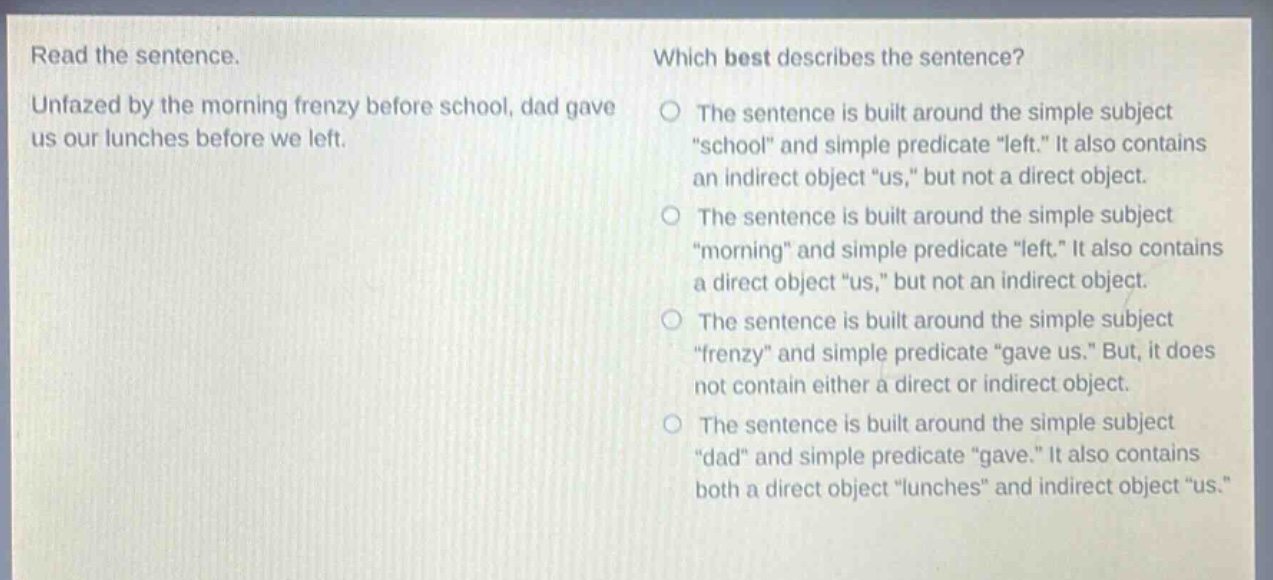
read the sentence. unfazed by the morning frenzy before school, dad gave us our lunches before we left. which best describes the sentence? the sentence is built around the simple subject \school\ and simple predicate \left.\ it also contains an indirect object \us,\ but not a direct object. the sentence is built around the simple subject \morning\ and simple predicate \left.\ it also contains a direct object \us,\ but not an indirect object. the sentence is built around the simple subject \frenzy\ and simple predicate \gave us.\ but, it does not contain either a direct or indirect object. the sentence is built around the simple subject \dad\ and simple predicate \gave.\ it also contains both a direct object \lunches\ and indirect object \us.\
Answer
Brief Explanations:
The subject of the sentence is who is performing the action, which is "dad". The verb "gave" is the simple predicate. The direct - object is what receives the action directly ("lunches"), and the indirect - object is to whom the action is done ("us").
Answer:
The sentence is built around the simple subject "dad" and simple predicate "gave." It also contains both a direct object "lunches" and indirect object "us."