section 2\nwhoever, with intent or reason to believe that it is to be used to the injury or the united…
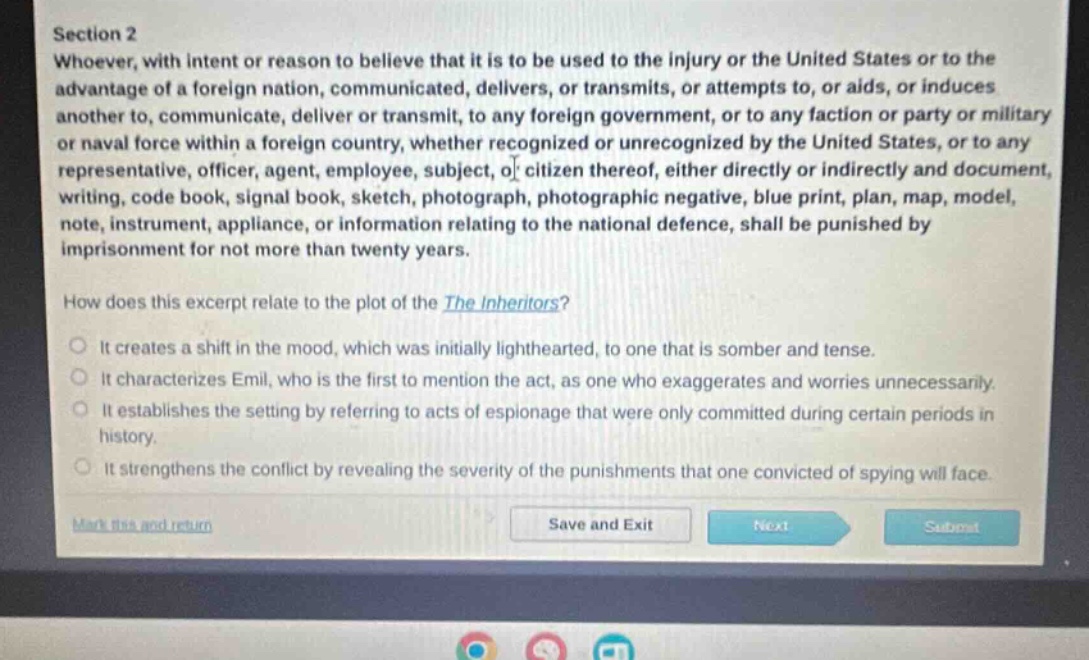
section 2\nwhoever, with intent or reason to believe that it is to be used to the injury or the united states or to the advantage of a foreign nation, communicated, delivers, or transmits, or attempts to, or aids, or induces another to, communicate, deliver or transmit, to any foreign government, or to any faction or party or military or naval force within a foreign country, whether recognized or unrecognized by the united states, or to any representative, officer, agent, employee, subject, or citizen thereof, either directly or indirectly and document, writing, code book, signal book, sketch, photograph, photographic negative, blue print, plan, map, model, note, instrument, appliance, or information relating to the national defence, shall be punished by imprisonment for not more than twenty years.\nhow does this excerpt relate to the plot of the the inheritors?\nit creates a shift in the mood, which was initially lighthearted, to one that is somber and tense.\nit characterizes emil, who is the first to mention the act, as one who exaggerates and worries unnecessarily.\nit establishes the setting by referring to acts of espionage that were only committed during certain periods in history.\nit strengthens the conflict by revealing the severity of the punishments that one convicted of spying will face.
Answer
Brief Explanations:
The excerpt details severe punishments for espionage - imprisonment up to twenty years. In a story context like The Inheritors, this would heighten the conflict by showing the gravity of being convicted of spying.
Answer:
It strengthens the conflict by revealing the severity of the punishments that one convicted of spying will face.