select the best evidence to support the statement \the task of returning art stolen during world war ii…
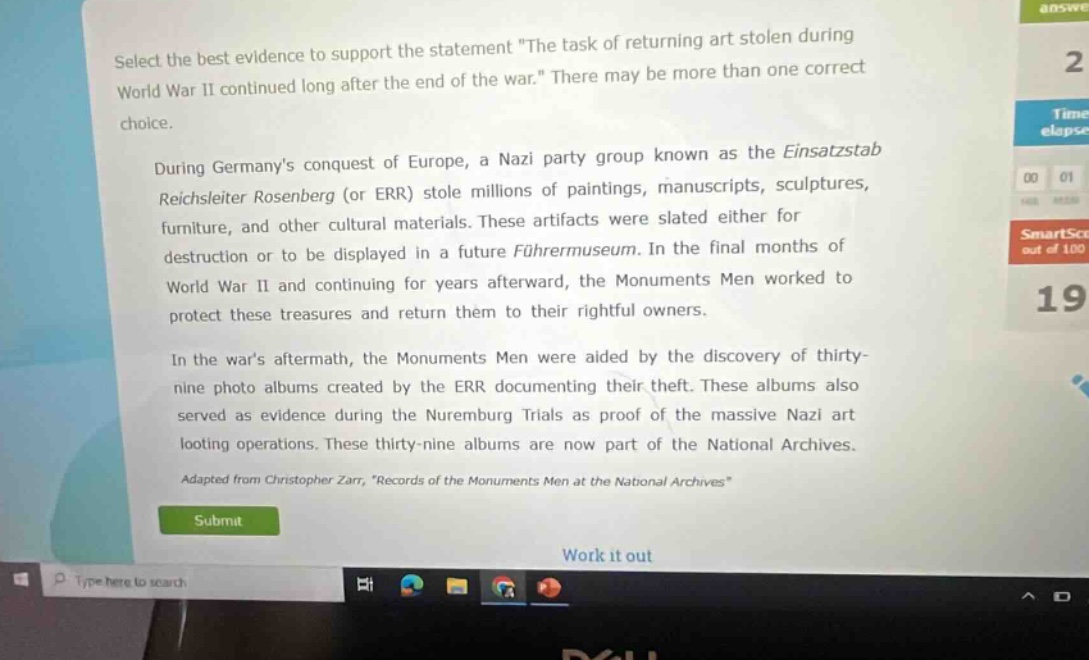
select the best evidence to support the statement \the task of returning art stolen during world war ii continued long after the end of the war.\ there may be more than one correct choice.\n\nduring germanys conquest of europe, a nazi party group known as the einsatzstab reichsleiter rosenberg (or err) stole millions of paintings, manuscripts, sculptures, furniture, and other cultural materials. these artifacts were slated either for destruction or to be displayed in a future führermuseum. in the final months of world war ii and continuing for years afterward, the monuments men worked to protect these treasures and return them to their rightful owners.\n\nin the wars aftermath, the monuments men were aided by the discovery of thirty - nine photo albums created by the err documenting their theft. these albums also served as evidence during the nuremburg trials as proof of the massive nazi art looting operations. these thirty - nine albums are now part of the national archives.\n\nadapted from christopher zarr, \records of the monuments men at the national archives\
Answer
Brief Explanations:
The text mentions that in the final months of World War II and for years afterward, the Monuments Men worked to return stolen art. Also, the discovery of photo - albums documenting the theft in the war's aftermath further shows the long - term nature of the return task.
Answer:
- During Germany's conquest of Europe, a Nazi party group known as the Einsatzstab Reichsleiter Rosenberg (or ERR) stole millions of paintings, manuscripts, sculptures, furniture, and other cultural materials. These artifacts were slated either for destruction or to be displayed in a future Führermuseum. In the final months of World War II and continuing for years afterward, the Monuments Men worked to protect these treasures and return them to their rightful owners.
- In the war's aftermath, the Monuments Men were aided by the discovery of thirty - nine photo albums created by the ERR documenting their theft. These albums also served as evidence during the Nuremburg Trials as proof of the massive Nazi art looting operations. These thirty - nine albums are now part of the National Archives.