text 1\nmany scientists argue that people who find relief through many herbal remedies are actually…
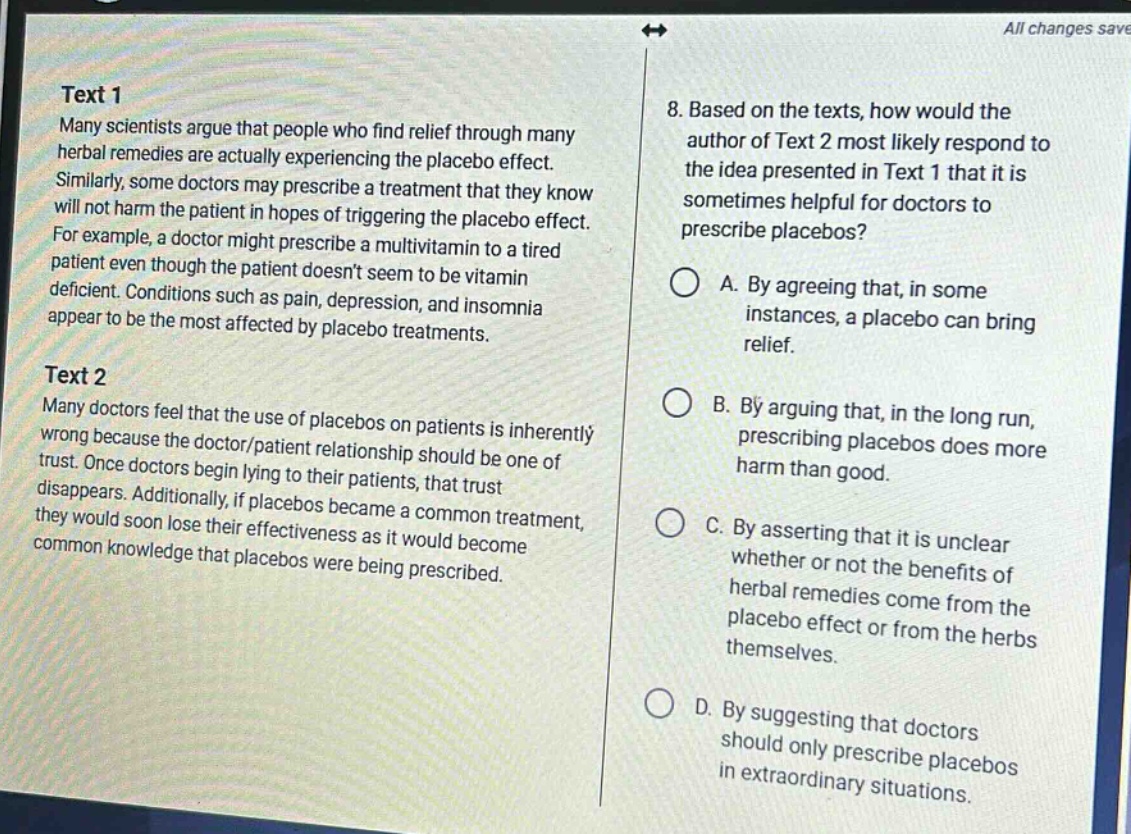
text 1\nmany scientists argue that people who find relief through many herbal remedies are actually experiencing the placebo effect. similarly, some doctors may prescribe a treatment that they know will not harm the patient in hopes of triggering the placebo effect. for example, a doctor might prescribe a multivitamin to a tired patient even though the patient doesnt seem to be vitamin - deficient. conditions such as pain, depression, and insomnia appear to be the most affected by placebo treatments.\ntext 2\nmany doctors feel that the use of placebos on patients is inherently wrong because the doctor/patient relationship should be one of trust. once doctors begin lying to their patients, that trust disappears. additionally, if placebos became a common treatment, they would soon lose their effectiveness as it would become common knowledge that placebos were being prescribed.\n8. based on the texts, how would the author of text 2 most likely respond to the idea presented in text 1 that it is sometimes helpful for doctors to prescribe placebos?\na. by agreeing that, in some instances, a placebo can bring relief.\nb. by arguing that, in the long run, prescribing placebos does more harm than good.\nc. by asserting that it is unclear whether or not the benefits of herbal remedies come from the placebo effect or from the herbs themselves.\nd. by suggesting that doctors should only prescribe placebos in extraordinary situations.
Answer
Brief Explanation:
Text 2 emphasizes that using placebos is wrong as it undermines doctor - patient trust and their effectiveness would be lost if common. So the author of Text 2 would likely oppose the idea in Text 1 that prescribing placebos can be helpful sometimes.
Answer:
B. By arguing that, in the long run, prescribing placebos does more harm than good.