how can the two independent clauses below be combined to form a correct complete sentence? check all that…
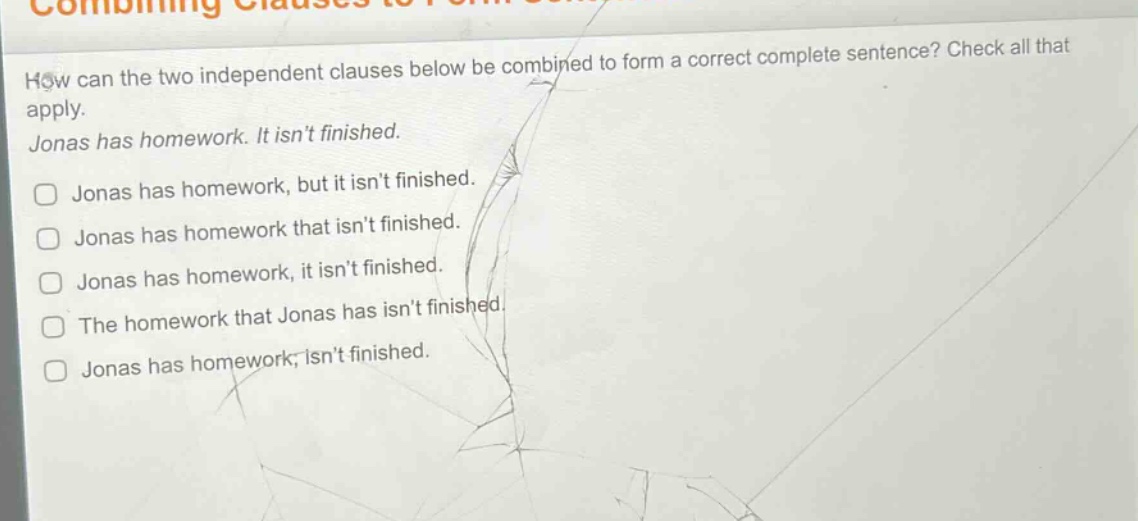
how can the two independent clauses below be combined to form a correct complete sentence? check all that apply. jonas has homework. it isnt finished. jonas has homework, but it isnt finished. jonas has homework that isnt finished. jonas has homework, it isnt finished. the homework that jonas has isnt finished. jonas has homework; isnt finished.
Answer
Answer:
A. Jonas has homework, but it isn't finished. B. Jonas has homework that isn't finished. D. The homework that Jonas has isn't finished.
Brief Explanations:
A uses a coordinating - conjunction "but" to combine the clauses. B and D use relative - clause structures to merge the ideas. The other options have punctuation or grammar errors.