10 - 47. when the net at right is folded, it creates a die with values as shown. 10 - 67 hw etool cpm…
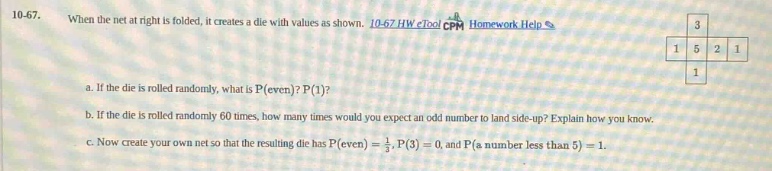
10 - 47. when the net at right is folded, it creates a die with values as shown. 10 - 67 hw etool cpm homework help a. if the die is rolled randomly, what is p(even)? p(1)? b. if the die is rolled randomly 60 times, how many times would you expect an odd number to land side - up? explain how you know. c. now create your own net so that the resulting die has p(even)=$\\frac{1}{3}$,p(3)=0, and p(a number less than 5)=1.
Answer
Explanation:
Step1: Identify total and favorable outcomes for part a
The die has 6 faces with values 1, 1, 1, 2, 3, 5. Total number of outcomes $n = 6$. Even - numbered faces are 2, so number of favorable outcomes for even $n_{even}=1$. For $P(1)$, number of 1 - faces $n_1 = 3$. $P(\text{even})=\frac{n_{even}}{n}=\frac{1}{6}$; $P(1)=\frac{n_1}{n}=\frac{3}{6}=\frac{1}{2}$
Step2: Calculate expected number for part b
The odd - numbered faces are 1, 1, 1, 3, 5. So number of odd - numbered faces $n_{odd}=5$. Probability of getting an odd number $P(\text{odd})=\frac{n_{odd}}{n}=\frac{5}{6}$. If the die is rolled $N = 60$ times, the expected number of times an odd number lands side - up $E=n_{odd}\times N$. $E=\frac{5}{6}\times60 = 50$
Step3: Design net for part c
Since $P(\text{even})=\frac{1}{3}$, out of 6 faces, number of even - numbered faces $n_{even}=\frac{1}{3}\times6 = 2$. Since $P(3)=0$, there are no 3s. Since $P(\text{a number less than }5)=1$, all numbers are less than 5. A possible net could have two 2s, four 4s.
Answer:
a. $P(\text{even})=\frac{1}{6}$, $P(1)=\frac{1}{2}$ b. 50 times. The probability of getting an odd number is $\frac{5}{6}$, and when rolled 60 times, $E=\frac{5}{6}\times60 = 50$. c. A possible net has two 2s and four 4s.