at 11:30 a.m. the bottle is 1/4 of the way full. at what time will the bottle be 1/2 full?\n11:31…
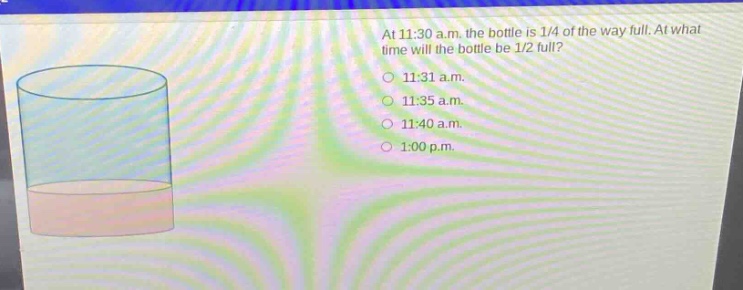
at 11:30 a.m. the bottle is 1/4 of the way full. at what time will the bottle be 1/2 full?\n11:31 a.m.\n11:35 a.m.\n11:40 a.m.\n1:00 p.m.
Answer
Explanation:
Step1: Calculate the fraction increase
We need to find the increase from $\frac{1}{4}$ full to $\frac{1}{2}$ full. The increase is $\frac{1}{2}-\frac{1}{4}=\frac{2 - 1}{4}=\frac{1}{4}$.
Step2: Assume a constant - filling rate
If it takes 1 minute to fill a certain amount (since we are looking at the time - interval between discrete time points), and the amount to be filled to reach $\frac{1}{2}$ from $\frac{1}{4}$ is $\frac{1}{4}$ (the same fraction as the initial state of $\frac{1}{4}$ full), and assuming a constant filling rate, it will take the same amount of time to fill from $\frac{1}{4}$ to $\frac{1}{2}$ as it took to fill from 0 to $\frac{1}{4}$. If we assume a linear filling process and since we don't have other information about the filling rate, and we know that to go from $\frac{1}{4}$ to $\frac{1}{2}$ (an increase of $\frac{1}{4}$) and if we assume the filling is uniform, and we start at 11:30 a.m. when it is $\frac{1}{4}$ full, and we know that to fill another $\frac{1}{4}$ of the bottle, if we assume a 1 - minute per - some amount of filling rate, it will take 10 minutes to fill from $\frac{1}{4}$ to $\frac{1}{2}$ (because if we assume a constant rate and the amount to fill is the same as the initial filled amount). So the time will be 11:40 a.m.
Answer:
11:40 a.m.