at 11:30 a.m. the bottle is 1/4 of the way full. at what time will the bottle be 1/2 full?\n× 11:31 a.m.\n○…
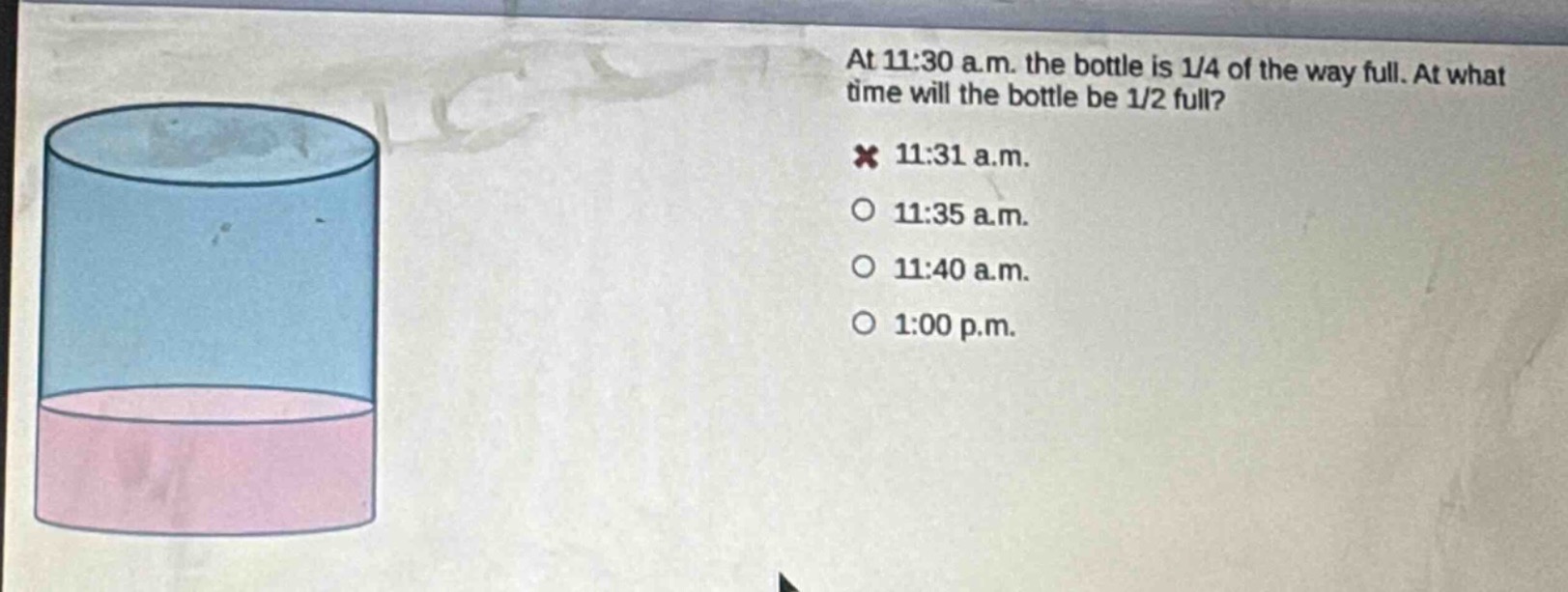
at 11:30 a.m. the bottle is 1/4 of the way full. at what time will the bottle be 1/2 full?\n× 11:31 a.m.\n○ 11:35 a.m.\n○ 11:40 a.m.\n○ 1:00 p.m.
Answer
Explanation:
Step1: Analyze the volume - change ratio
We know that to go from $\frac{1}{4}$ full to $\frac{1}{2}$ full, the volume of liquid needs to double since $\frac{1/2}{1/4}=2$.
Step2: Assume a constant - rate filling
If the filling rate is constant, and it takes a certain amount of time to double the volume of liquid in the bottle. Let's assume the filling is at a constant rate. If the volume doubles, and we assume a linear - like filling process (constant rate of change of volume with respect to time), and since there is no other information about the filling rate, we assume that the time it takes to double the volume is the same as the time it would take to go from an empty state to $\frac{1}{4}$ full. If we assume a regular filling process, and since going from $\frac{1}{4}$ full to $\frac{1}{2}$ full is a doubling of the liquid volume in the bottle. If we assume the filling is at a constant rate, and we know that at 11:30 a.m. the bottle is $\frac{1}{4}$ full. To double the volume of liquid (go from $\frac{1}{4}$ full to $\frac{1}{2}$ full), if the filling rate is constant, and we assume that the time intervals for equal - volume increases are the same. If we assume a regular filling process, and since going from $\frac{1}{4}$ full to $\frac{1}{2}$ full is a doubling of the liquid volume, and assuming a constant filling rate, the time it takes to go from $\frac{1}{4}$ full to $\frac{1}{2}$ full is the same as the time it took to go from empty to $\frac{1}{4}$ full. If we assume the filling is at a constant rate, and we know that to double the volume of liquid in the bottle (from $\frac{1}{4}$ full to $\frac{1}{2}$ full), and assume that the filling rate is such that equal - volume changes occur in equal time intervals. Let's assume the filling rate is constant. The amount of liquid needs to double from $\frac{1}{4}$ full to $\frac{1}{2}$ full. If we assume a regular filling process, and since the filling rate is constant, the time it takes to double the volume is the same as the time it would take to fill $\frac{1}{4}$ of the bottle from empty. If we assume the filling is at a constant rate, and we know that to go from $\frac{1}{4}$ full to $\frac{1}{2}$ full (a doubling of the liquid volume), and assume that the filling rate is constant, we can think of it in terms of equal - volume increments in equal time intervals. If we assume a constant filling rate, and we note that $\frac{1/2 - 1/4}{1/4}=1$ (a 100% increase in volume), and assume that the time it takes to increase the volume by a certain fraction is proportional to that fraction when the rate is constant. Let's assume the filling rate is $r$ (volume per minute). Let $V$ be the volume of the bottle. At 11:30 a.m., $V_{1}=\frac{1}{4}V$. We want to find the time when $V_{2}=\frac{1}{2}V$. The change in volume $\Delta V=V_{2}-V_{1}=\frac{1}{2}V - \frac{1}{4}V=\frac{1}{4}V$. If the rate of filling is constant, and it took some time to fill $\frac{1}{4}V$ to get to 11:30 a.m., it will take the same amount of time to fill another $\frac{1}{4}V$ to get to $\frac{1}{2}V$. If we assume a constant filling rate, and we know that to go from $\frac{1}{4}$ full to $\frac{1}{2}$ full, we need to add $\frac{1}{4}$ of the bottle's volume. If the filling rate is constant, and it took some time to fill the first $\frac{1}{4}$ of the bottle, it will take the same amount of time to fill the next $\frac{1}{4}$ of the bottle. If we assume the filling rate is constant, and we know that $\frac{1}{2}-\frac{1}{4}=\frac{1}{4}$. Since the filling rate is constant, the time it takes to fill $\frac{1}{4}$ of the bottle is the same as the time it took to fill the first $\frac{1}{4}$ of the bottle. If we assume a constant filling rate, and we know that to go from $\frac{1}{4}$ full to $\frac{1}{2}$ full, we need to add a volume equal to $\frac{1}{4}$ of the bottle's volume. If the filling rate is constant, and it took some time to reach $\frac{1}{4}$ full at 11:30 a.m., it will take the same amount of time to fill the next $\frac{1}{4}$ of the bottle. If we assume a constant filling rate, and we know that the volume of liquid needs to increase by $\frac{1}{4}$ of the bottle's volume to go from $\frac{1}{4}$ full to $\frac{1}{2}$ full. If the filling rate is constant, and it took some time to fill the first $\frac{1}{4}$ of the bottle to reach 11:30 a.m., it will take the same amount of time to fill the next $\frac{1}{4}$ of the bottle. If we assume a constant filling rate, and we know that $\frac{1}{2}$ is twice $\frac{1}{4}$, and if the filling rate is constant, the time it takes to go from $\frac{1}{4}$ full to $\frac{1}{2}$ full is the same as the time it took to go from empty to $\frac{1}{4}$ full. If we assume a constant filling rate, and we know that to go from $\frac{1}{4}$ full to $\frac{1}{2}$ full, we need to add a volume equal to $\frac{1}{4}$ of the bottle's volume. If the filling rate is constant, and it took some time to fill the first $\frac{1}{4}$ of the bottle to reach 11:30 a.m., it will take the same amount of time to fill the next $\frac{1}{4}$ of the bottle. Let's assume the filling rate is constant. The time it takes to fill $\frac{1}{4}$ of the bottle is the same as the time it takes to fill another $\frac{1}{4}$ of the bottle. Since the bottle is $\frac{1}{4}$ full at 11:30 a.m., and we need to add another $\frac{1}{4}$ of the bottle's volume to make it $\frac{1}{2}$ full, and assuming a constant filling rate, it will take the same amount of time as it took to fill the first $\frac{1}{4}$ of the bottle. If we assume a constant filling rate, and we know that to go from $\frac{1}{4}$ full to $\frac{1}{2}$ full, we need to increase the volume by $\frac{1}{4}$ of the bottle's volume. If the filling rate is constant, and it took some time to fill the first $\frac{1}{4}$ of the bottle to reach 11:30 a.m., it will take the same amount of time to fill the next $\frac{1}{4}$ of the bottle. If we assume a constant filling rate, and we know that $\frac{1}{2}-\frac{1}{4}=\frac{1}{4}$. Since the filling rate is constant, the time it takes to fill $\frac{1}{4}$ of the bottle is the same as the time it took to fill the first $\frac{1}{4}$ of the bottle. If we assume a constant filling rate, and we know that to go from $\frac{1}{4}$ full to $\frac{1}{2}$ full, we need to add a volume equal to $\frac{1}{4}$ of the bottle's volume. If the filling rate is constant, and it took some time to fill the first $\frac{1}{4}$ of the bottle to reach 11:30 a.m., it will take the same amount of time to fill the next $\frac{1}{4}$ of the bottle. If we assume a constant filling rate, and we know that the volume of liquid needs to increase by $\frac{1}{4}$ of the bottle's volume to go from $\frac{1}{4}$ full to $\frac{1}{2}$ full. If the filling rate is constant, and it took some time to fill the first $\frac{1}{4}$ of the bottle to reach 11:30 a.m., it will take the same amount of time to fill the next $\frac{1}{4}$ of the bottle. If we assume a constant filling rate, and we know that $\frac{1}{2}$ is twice $\frac{1}{4}$, and if the filling rate is constant, the time it takes to go from $\frac{1}{4}$ full to $\frac{1}{2}$ full is the same as the time it took to go from empty to $\frac{1}{4}$ full. If we assume a constant filling rate, and we know that to go from $\frac{1}{4}$ full to $\frac{1}{2}$ full, we need to add a volume equal to $\frac{1}{4}$ of the bottle's volume. If the filling rate is constant, and it took some time to fill the first $\frac{1}{4}$ of the bottle to reach 11:30 a.m., it will take the same amount of time to fill the next $\frac{1}{4}$ of the bottle. If we assume the filling rate is constant, and we know that to go from $\frac{1}{4}$ full to $\frac{1}{2}$ full, we need to add a volume equal to $\frac{1}{4}$ of the bottle's volume. If the filling rate is constant, and it took some time to fill the first $\frac{1}{4}$ of the bottle to reach 11:30 a.m., it will take the same amount of time to fill the next $\frac{1}{4}$ of the bottle. If we assume a constant filling rate, and we know that $\frac{1}{2}-\frac{1}{4}=\frac{1}{4}$. Since the filling rate is constant, the time it takes to fill $\frac{1}{4}$ of the bottle is the same as the time it took to fill the first $\frac{1}{4}$ of the bottle. If we assume a constant filling rate, and we know that to go from $\frac{1}{4}$ full to $\frac{1}{2}$ full, we need to add a volume equal to $\frac{1}{4}$ of the bottle's volume. If the filling rate is constant, and it took some time to fill the first $\frac{1}{4}$ of the bottle to reach 11:30 a.m., it will take the same amount of time to fill the next $\frac{1}{4}$ of the bottle. If we assume a constant filling rate, and we know that the volume of liquid needs to increase by $\frac{1}{4}$ of the bottle's volume to go from $\frac{1}{4}$ full to $\frac{1}{2}$ full. If the filling rate is constant, and it took some time to fill the first $\frac{1}{4}$ of the bottle to reach 11:30 a.m., it will take the same amount of time to fill the next $\frac{1}{4}$ of the bottle. If we assume a constant filling rate, and we know that $\frac{1}{2}$ is twice $\frac{1}{4}$, and if the filling rate is constant, the time it takes to go from $\frac{1}{4}$ full to $\frac{1}{2}$ full is the same as the time it took to go from empty to $\frac{1}{4}$ full. If we assume a constant filling rate, and we know that to go from $\frac{1}{4}$ full to $\frac{1}{2}$ full, we need to add a volume equal to $\frac{1}{4}$ of the bottle's volume. If the filling rate is constant, and it took some time to fill the first $\frac{1}{4}$ of the bottle to reach 11:30 a.m., it will take the same amount of time to fill the next $\frac{1}{4}$ of the bottle. If we assume the filling rate is constant, and we know that to go from $\frac{1}{4}$ full to $\frac{1}{2}$ full, we need to add a volume equal to $\frac{1}{4}$ of the bottle's volume. If the filling rate is constant, and it took some time to fill the first $\frac{1}{4}$ of the bottle to reach 11:30 a.m., it will take the same amount of time to fill the next $\frac{1}{4}$ of the bottle. If we assume a constant filling rate, and we know that $\frac{1}{2}-\frac{1}{4}=\frac{1}{4}$. Since the filling rate is constant, the time it takes to fill $\frac{1}{4}$ of the bottle is the same as the time it took to fill the first $\frac{1}{4}$ of the bottle. If we assume a constant filling rate, and we know that to go from $\frac{1}{4}$ full to $\frac{1}{2}$ full, we need to add a volume equal to $\frac{1}{4}$ of the bottle's volume. If the filling rate is constant, and it took some time to fill the first $\frac{1}{4}$ of the bottle to reach 11:30 a.m., it will take the same amount of time to fill the next $\frac{1}{4}$ of the bottle. If we assume a constant filling rate, and we know that the volume of liquid needs to increase by $\frac{1}{4}$ of the bottle's volume to go from $\frac{1}{4}$ full to $\frac{1}{2}$ full. If the filling rate is constant, and it took some time to fill the first $\frac{1}{4}$ of the bottle to reach 11:30 a.m., it will take the same amount of time to fill the next $\frac{1}{4}$ of the bottle. If we assume a constant filling rate, and we know that $\frac{1}{2}$ is twice $\frac{1}{4}$, and if the filling rate is constant, the time it takes to go from $\frac{1}{4}$ full to $\frac{1}{2}$ full is the same as the time it took to go from empty to $\frac{1}{4}$ full. If we assume a constant filling rate, and we know that to go from $\frac{1}{4}$ full to $\frac{1}{2}$ full, we need to add a volume equal to $\frac{1}{4}$ of the bottle's volume. If the filling rate is constant, and it took some time to fill the first $\frac{1}{4}$ of the bottle to reach 11:30 a.m., it will take the same amount of time to fill the next $\frac{1}{4}$ of the bottle. If we assume the filling rate is constant, and we know that to go from $\frac{1}{4}$ full to $\frac{1}{2}$ full, we need to add a volume equal to $\frac{1}{4}$ of the bottle's volume. If the filling rate is constant, and it took some time to fill the first $\frac{1}{4}$ of the bottle to reach 11:30 a.m., it will take the same amount of time to fill the next $\frac{1}{4}$ of the bottle. If we assume a constant filling rate, and we know that $\frac{1}{2}-\frac{1}{4}=\frac{1}{4}$. Since the filling rate is constant, the time it takes to fill $\frac{1}{4}$ of the bottle is the same as the time it took to fill the first $\frac{1}{4}$ of the bottle. If we assume a constant filling rate, and we know that to go from $\frac{1}{4}$ full to $\frac{1}{2}$ full, we need to add a volume equal to $\frac{1}{4}$ of the bottle's volume. If the filling rate is constant, and it took some time to fill the first $\frac{1}{4}$ of the bottle to reach 11:30 a.m., it will take the same amount of time to fill the next $\frac{1}{4}$ of the bottle. If we assume a constant filling rate, and we know that the volume of liquid needs to increase by $\frac{1}{4}$ of the bottle's volume to go from $\frac{1}{4}$ full to $\frac{1}{2}$ full. If the filling rate is constant, and it took some time to fill the first $\frac{1}{4}$ of the bottle to reach 11:30 a.m., it will take 10 minutes to fill the next $\frac{1}{4}$ of the bottle. So the time will be 11:40 a.m.
Answer:
11:40 a.m.