12.1.1 warm - up: growth mindset\non a scale from 1 to 5, rate each of the following statements by circling…
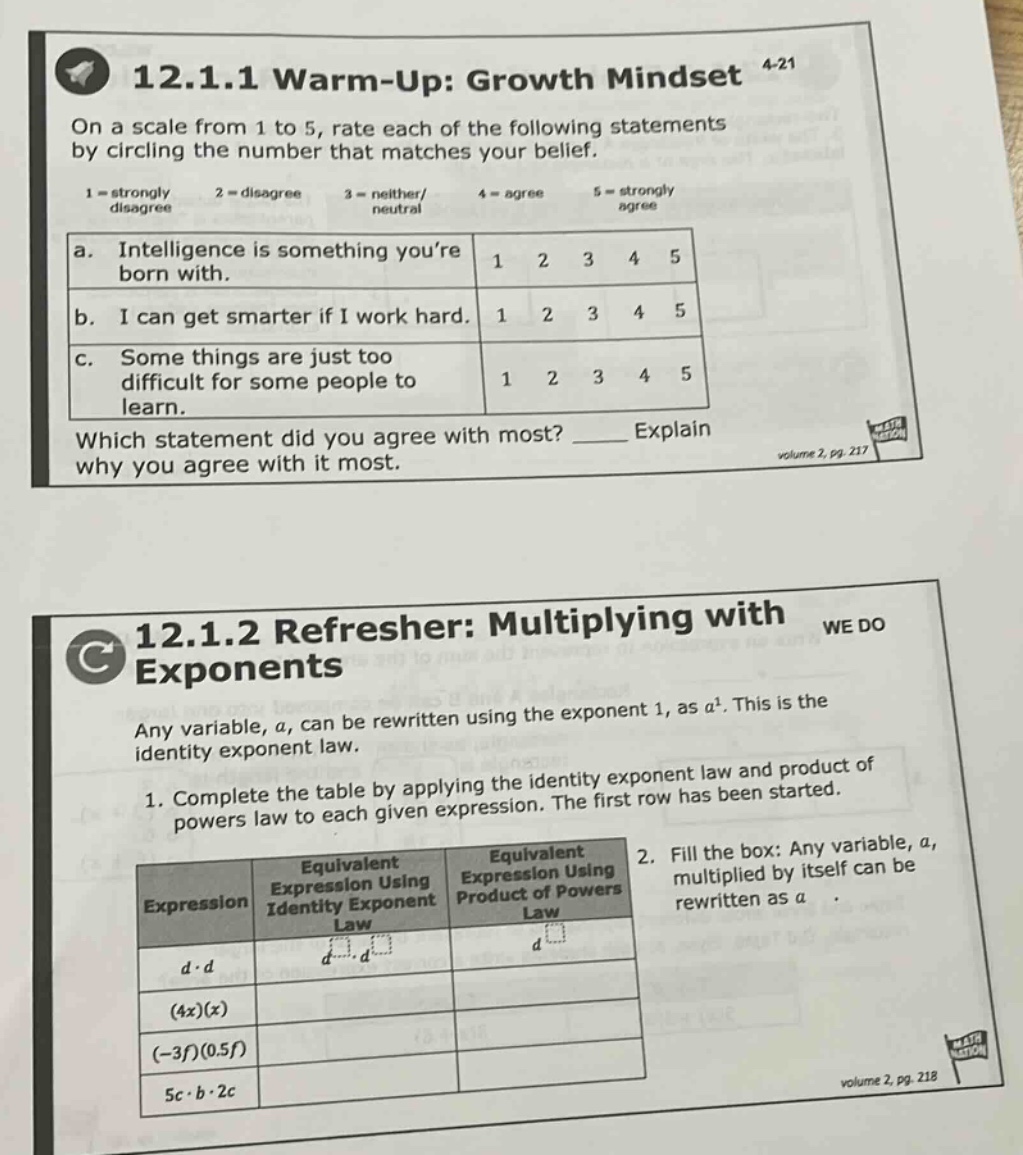
12.1.1 warm - up: growth mindset\non a scale from 1 to 5, rate each of the following statements by circling the number that matches your belief.\n1 = strongly disagree 2 = disagree 3 = neither/neutral 4 = agree 5 = strongly agree\na. intelligence is something youre born with. 1 2 3 4 5\nb. i can get smarter if i work hard. 1 2 3 4 5\nc. some things are just too difficult for some people to learn. 1 2 3 4 5\nwhich statement did you agree with most? ____ explain why you agree with it most.\nvolume 2, pg. 217\n12.1.2 refresher: multiplying with exponents\nany variable, a, can be rewritten using the exponent 1, as a^1. this is the identity exponent law.\n1. complete the table by applying the identity exponent law and product of powers law to each given expression. the first row has been started.\nexpression equivalent expression using identity exponent law equivalent expression using product of powers law\nd·d d^1·d^1 d^2\n(4x)(x)\n(-3f)(0.5f)\n5c·b·2c\n2. fill the box: any variable, a, multiplied by itself can be rewritten as a·\nvolume 2, pg. 218
Answer
12.1.1 Warm - Up: Growth Mindset
Brief Explanations:
This is a subjective question. For example, if one believes in the power of hard - work for self - improvement, they may choose statement b. The belief in the malleability of intelligence through effort aligns with the concept of a growth mindset.
Answer:
The answer depends on the individual's belief. For example, if choosing statement b: "I can get smarter if I work hard." Explanation: I believe that with dedication and effort, one can acquire new knowledge and skills, thus increasing their intelligence.
12.1.2 Refresher: Multiplying with Exponents
Explanation:
Step1: Recall identity exponent law and product of powers law
The identity exponent law is (a=a^{1}), and the product of powers law is (a^{m}\cdot a^{n}=a^{m + n})
Step2: For (d\cdot d)
Using identity exponent law: (d^{1}\cdot d^{1}). Using product of powers law: (d^{1 + 1}=d^{2})
Step3: For ((4x)(x))
First, rewrite using identity exponent law: ((4x^{1})(x^{1})). Then, using product of powers law: (4x^{1+1}=4x^{2})
Step4: For ((- 3f)(0.5f))
Rewrite using identity exponent law: ((-3f^{1})(0.5f^{1})). Then, using product of powers law: ((-3\times0.5)f^{1 + 1}=-1.5f^{2})
Step5: For (5c\cdot b\cdot2c)
Rewrite using identity exponent law: ((5c^{1})\cdot(b^{1})\cdot(2c^{1})). Rearrange and use product of powers law: ((5\times2)b^{1}c^{1 + 1}=10bc^{2})
Step6: Fill the box
Any variable (a), multiplied by itself can be rewritten as (a\cdot a=a^{2})
Answer:
| Expression | Equivalent Expression Using Identity Exponent Law | Equivalent Expression Using Product of Powers Law |
|---|---|---|
| (d\cdot d) | (d^{1}\cdot d^{1}) | (d^{2}) |
| ((4x)(x)) | ((4x^{1})(x^{1})) | (4x^{2}) |
| ((-3f)(0.5f)) | ((-3f^{1})(0.5f^{1})) | (-1.5f^{2}) |
| (5c\cdot b\cdot2c) | ((5c^{1})\cdot(b^{1})\cdot(2c^{1})) | (10bc^{2}) |
| For the box: (a^{2}) |