37. what main factor determines the path a star will take during its life cycle? 38. list the types of waves…
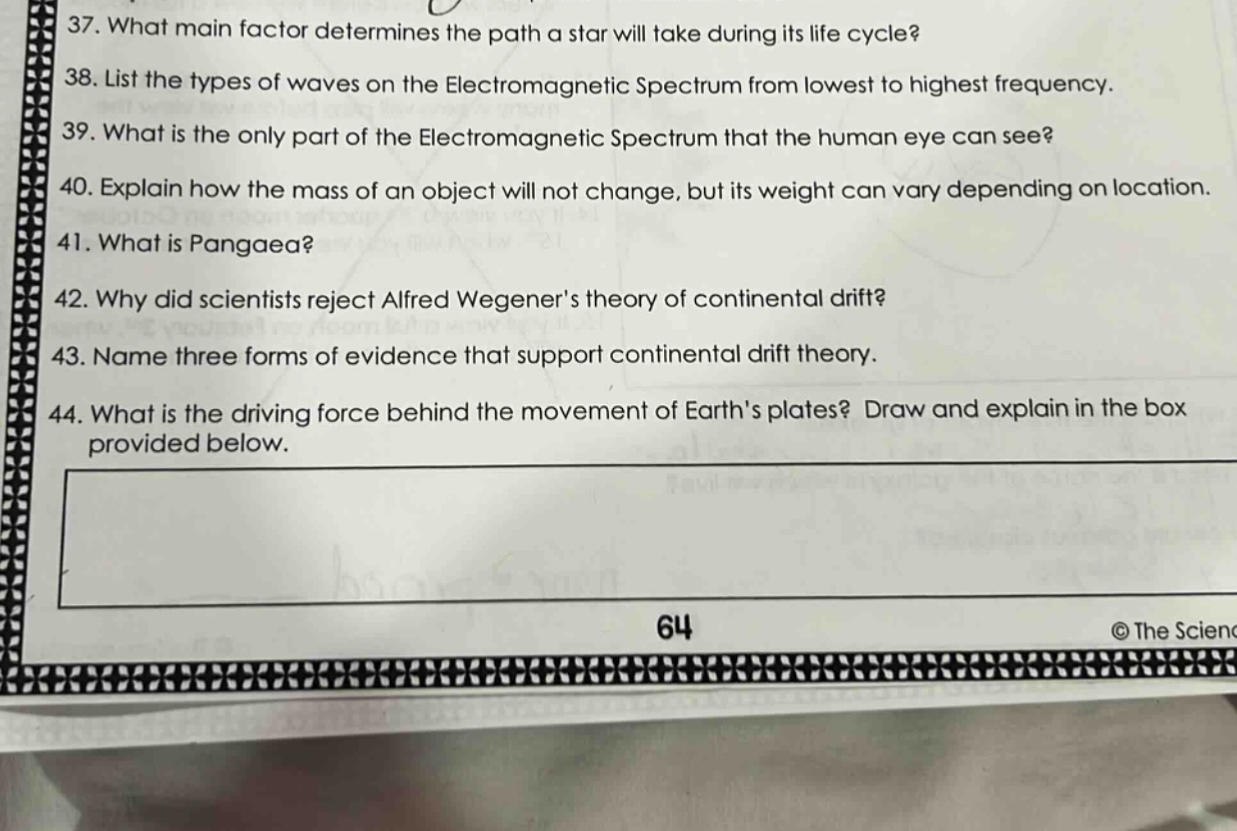
37. what main factor determines the path a star will take during its life cycle? 38. list the types of waves on the electromagnetic spectrum from lowest to highest frequency. 39. what is the only part of the electromagnetic spectrum that the human eye can see? 40. explain how the mass of an object will not change, but its weight can vary depending on location. 41. what is pangaea? 42. why did scientists reject alfred wegeners theory of continental drift? 43. name three forms of evidence that support continental drift theory. 44. what is the driving force behind the movement of earths plates? draw and explain in the box provided below.
Answer
Brief Explanations:
- The mass of a star determines its life - cycle path as it affects processes like nuclear fusion and gravitational collapse.
- Radio waves, microwaves, infrared, visible light, ultraviolet, X - rays, gamma rays are in order of increasing frequency on the electromagnetic spectrum.
- Visible light is the part of the electromagnetic spectrum that the human eye can detect.
- Mass is a measure of the amount of matter in an object and is constant. Weight is the force of gravity on an object, and since gravitational acceleration varies by location (e.g., Earth vs. Moon), weight can change.
- Pangaea was a supercontinent that existed millions of years ago, where all the present - day continents were joined together.
- Scientists initially rejected Alfred Wegener's theory of continental drift because he could not adequately explain the mechanism driving the movement of the continents.
- Three forms of evidence for continental drift are: matching coastlines of continents (e.g., South America and Africa), similar fossils found on different continents, and similar rock formations across different continents.
- The driving force behind the movement of Earth's plates is convection currents in the mantle. Hot, less - dense material rises, cools, and then sinks, creating a circular motion that exerts a force on the overlying tectonic plates, causing them to move.
Answer:
- Mass of the star.
- Radio waves, microwaves, infrared, visible light, ultraviolet, X - rays, gamma rays.
- Visible light.
- Mass is amount of matter (constant), weight is gravitational force (varies with location).
- A supercontinent where all present - day continents were joined.
- Lack of an adequate mechanism for continental movement.
- Matching coastlines, similar fossils, similar rock formations.
- Convection currents in the mantle. Hot material rises, cools, and sinks, moving plates.