dan has 12 books on his shelf that he has not read, including 7 novels and 5 biographies. he wants to take 4…
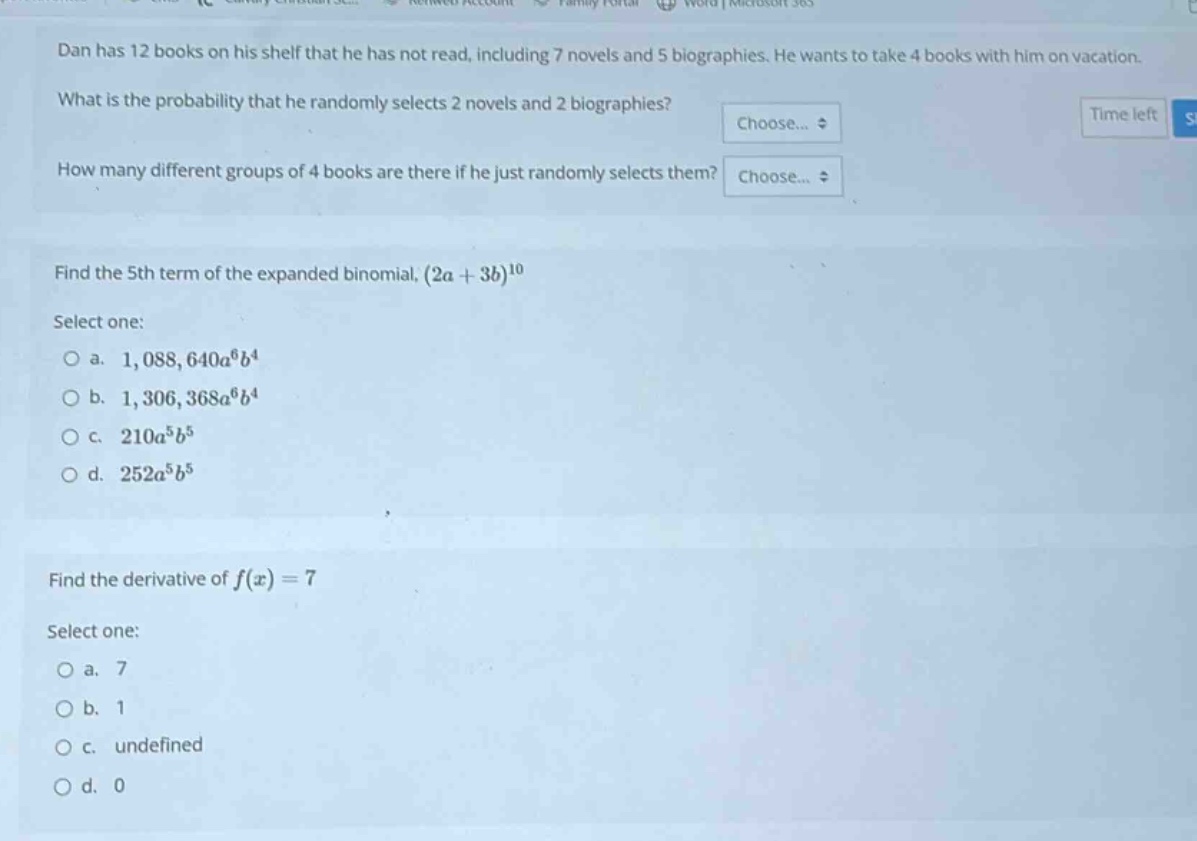
dan has 12 books on his shelf that he has not read, including 7 novels and 5 biographies. he wants to take 4 books with him on vacation. what is the probability that he randomly selects 2 novels and 2 biographies? how many different groups of 4 books are there if he just randomly selects them? find the 5th term of the expanded binomial, $(2a + 3b)^{10}$ select one: a. $1,088,640a^{6}b^{4}$ b. $1,306,368a^{6}b^{4}$ c. $210a^{5}b^{5}$ d. $252a^{5}b^{5}$ find the derivative of $f(x)=7$ select one: a. 7 b. 1 c. undefined d. 0
Answer
1. Probability of selecting 2 novels and 2 biographies
Answer:
$\frac{21}{55}$
Explanation:
Step1: Calculate total ways to choose 4 books
The number of ways to choose 4 books out of 12 is given by the combination formula $C(n,r)=\frac{n!}{r!(n - r)!}$, where $n = 12$ and $r=4$. So $C(12,4)=\frac{12!}{4!(12 - 4)!}=\frac{12\times11\times10\times9}{4\times3\times2\times1}=495$.
Step2: Calculate ways to choose 2 novels and 2 biographies
The number of ways to choose 2 novels out of 7 is $C(7,2)=\frac{7!}{2!(7 - 2)!}=\frac{7\times6}{2\times1}=21$. The number of ways to choose 2 biographies out of 5 is $C(5,2)=\frac{5!}{2!(5 - 2)!}=\frac{5\times4}{2\times1}=10$. The number of ways to choose 2 novels and 2 biographies is $C(7,2)\times C(5,2)=21\times10 = 210$.
Step3: Calculate the probability
The probability $P=\frac{\text{Number of favorable outcomes}}{\text{Total number of outcomes}}=\frac{210}{495}=\frac{21}{55}$.
2. Number of different groups of 4 - book selections
Answer:
495
Explanation:
Step1: Apply combination formula
Using the combination formula $C(n,r)=\frac{n!}{r!(n - r)!}$ with $n = 12$ and $r = 4$. So $C(12,4)=\frac{12!}{4!(12 - 4)!}=\frac{12\times11\times10\times9}{4\times3\times2\times1}=495$.
3. 5th term of the expanded binomial $(2a + 3b)^{10}$
Answer:
B. $1,306,368a^{6}b^{4}$
Explanation:
Step1: Recall binomial - theorem formula for the $k$th term
The $k$th term in the expansion of $(x + y)^n$ is given by $T_{k}=C(n,k - 1)x^{n-(k - 1)}y^{k - 1}$. Here $n = 10$, $k = 5$, $x = 2a$, $y = 3b$.
Step2: Calculate the binomial coefficient
$C(10,4)=\frac{10!}{4!(10 - 4)!}=\frac{10\times9\times8\times7}{4\times3\times2\times1}=210$.
Step3: Calculate the term
$T_{5}=C(10,4)(2a)^{10 - 4}(3b)^{4}=210\times2^{6}a^{6}\times3^{4}b^{4}=210\times64\times81a^{6}b^{4}=1306368a^{6}b^{4}$.
4. Derivative of $f(x)=7$
Answer:
D. 0
Explanation:
Step1: Recall the derivative of a constant function
The derivative of a constant function $y = C$ (where $C$ is a constant) is given by $\frac{dy}{dx}=0$. Since $f(x)=7$ is a constant function, $f^\prime(x)=0$.