which description is represented by a discrete graph?\no kiley bought a platter for $19 and several matching…
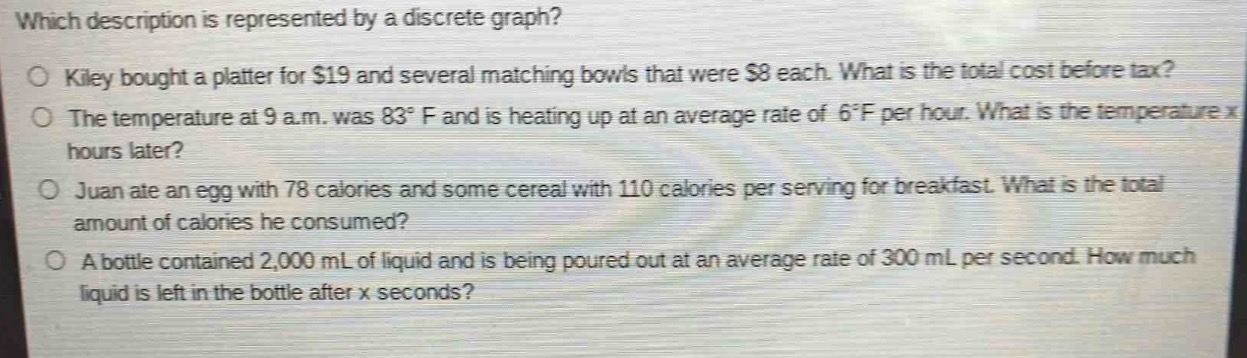
which description is represented by a discrete graph?\no kiley bought a platter for $19 and several matching bowls that were $8 each. what is the total cost before tax?\no the temperature at 9 a.m. was 83°f and is heating up at an average rate of 6°f per hour. what is the temperature x\nhours later?\no juan ate an egg with 78 calories and some cereal with 110 calories per serving for breakfast. what is the total\namount of calories he consumed?\no a bottle contained 2,000 ml of liquid and is being poured out at an average rate of 300 ml per second. how much\nliquid is left in the bottle after x seconds?
Answer
Explanation:
Step1: Understand discrete data
Discrete data consists of distinct, separate values.
Step2: Analyze each option
- Option 1: The number of bowls is a whole - number (0, 1, 2, …). The total cost $C = 19+8n$ where $n$ is the number of bowls. Since $n$ is a discrete variable (you can't buy a fraction of a bowl), the graph of the total cost will be discrete.
- Option 2: The number of hours $x$ can be any non - negative real number (e.g., 0.5 hours, 1.2 hours), and the temperature $T=83 + 6x$ is a continuous function of $x$. The graph will be continuous.
- Option 3: The number of servings of cereal is a whole - number (0, 1, 2, …). The total calories $C=78 + 110s$ where $s$ is the number of servings. Since $s$ is a discrete variable (you can't have a fraction of a serving), the graph of the total calories will be discrete.
- Option 4: The number of seconds $x$ can be any non - negative real number (e.g., 0.1 seconds, 0.2 seconds), and the amount of liquid $L = 2000-300x$ is a continuous function of $x$. The graph will be continuous.
Answer:
Kiley bought a platter for $19 and several matching bowls that were $8 each. What is the total cost before tax? and Juan ate an egg with 78 calories and some cereal with 110 calories per serving for breakfast. What is the total amount of calories he consumed?