3. the equation for the ideal gas law, $pv = nrt$, relates the pressure, $p$, the volume, $v$, the number of…
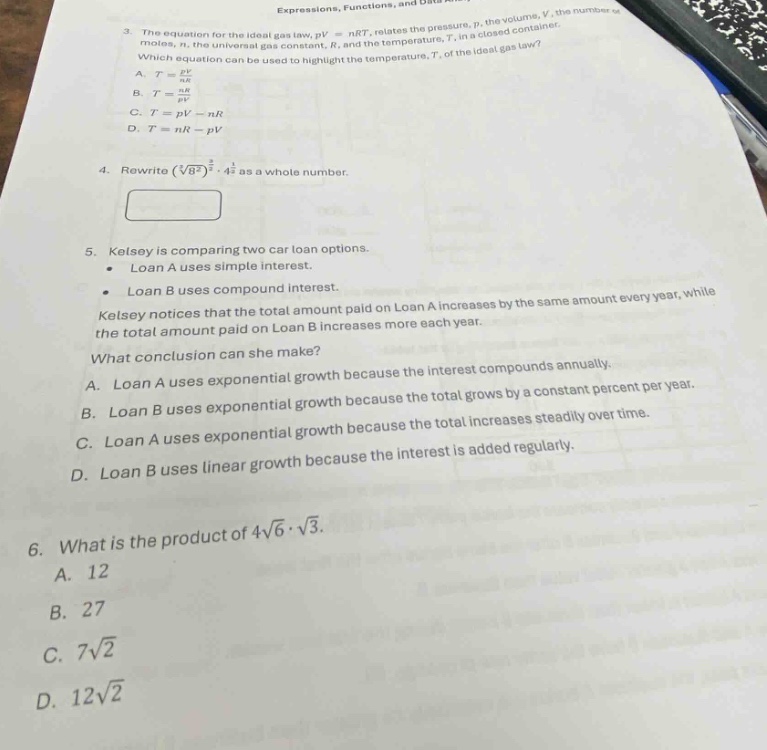
3. the equation for the ideal gas law, $pv = nrt$, relates the pressure, $p$, the volume, $v$, the number of moles, $n$, the universal gas constant, $r$, and the temperature, $t$, in a closed - container. which equation can be used to highlight the temperature, $t$, of the ideal gas law?\na. $t=\frac{pv}{nr}$\nb. $t = \frac{nr}{pv}$\nc. $t=pv - nr$\nd. $t=nr - pv$\n4. rewrite $(sqrt3{8})^{\frac{2}{3}}cdot4^{\frac{1}{2}}$ as a whole number.\n5. kelsey is comparing two car loan options.\n- loan a uses simple interest.\n- loan b uses compound interest.\nkelsey notices that the total amount paid on loan a increases by the same amount every year, while the total amount paid on loan b increases more each year.\nwhat conclusion can she make?\na. loan a uses exponential growth because the interest compounds annually.\nb. loan b uses exponential growth because the total increases steadily over time.\nc. loan a uses exponential growth because the interest is added regularly.\nd. loan b uses linear growth because the interest is added regularly.\n6. what is the product of $4sqrt{6}cdotsqrt{3}$.\na. 12\nb. 27\nc. $7sqrt{2}$\nd. $12sqrt{2}$
Answer
3.
Explanation:
Step1: Isolate $T$ in $pV = nRT$
Divide both sides by $nR$. $T=\frac{pV}{nR}$
Answer:
A. $T = \frac{pV}{nR}$
4.
Explanation:
Step1: Simplify $(\sqrt[3]{8})^2$
Since $\sqrt[3]{8}=2$, then $(\sqrt[3]{8})^2 = 2^2=4$.
Step2: Simplify $4^{\frac{1}{2}}$
$4^{\frac{1}{2}}=\sqrt{4} = 2$.
Step3: Multiply the results
$4\times2 = 8$.
Answer:
8
5.
Explanation:
Step1: Recall linear and exponential growth
Simple - interest (Loan A) has a constant - amount increase each year, which is linear growth. Compound - interest (Loan B) has a growth where the amount of increase is based on the previous total (interest compounds on the principal and accumulated interest), which is exponential growth.
Answer:
B. Loan B uses exponential growth because the total increases steadily over time.
6.
Explanation:
Step1: Multiply the square - root terms
$4\sqrt{6}\cdot\sqrt{3}=4\sqrt{6\times3}=4\sqrt{18}$.
Step2: Simplify $\sqrt{18}$
$\sqrt{18}=\sqrt{9\times2}=3\sqrt{2}$.
Step3: Calculate the final result
$4\times3\sqrt{2}=12\sqrt{2}$.
Answer:
D. $12\sqrt{2}$