this equation represents the ideal gas law, where (t) is the temperature. (pv = nrt). rearrange the equation…
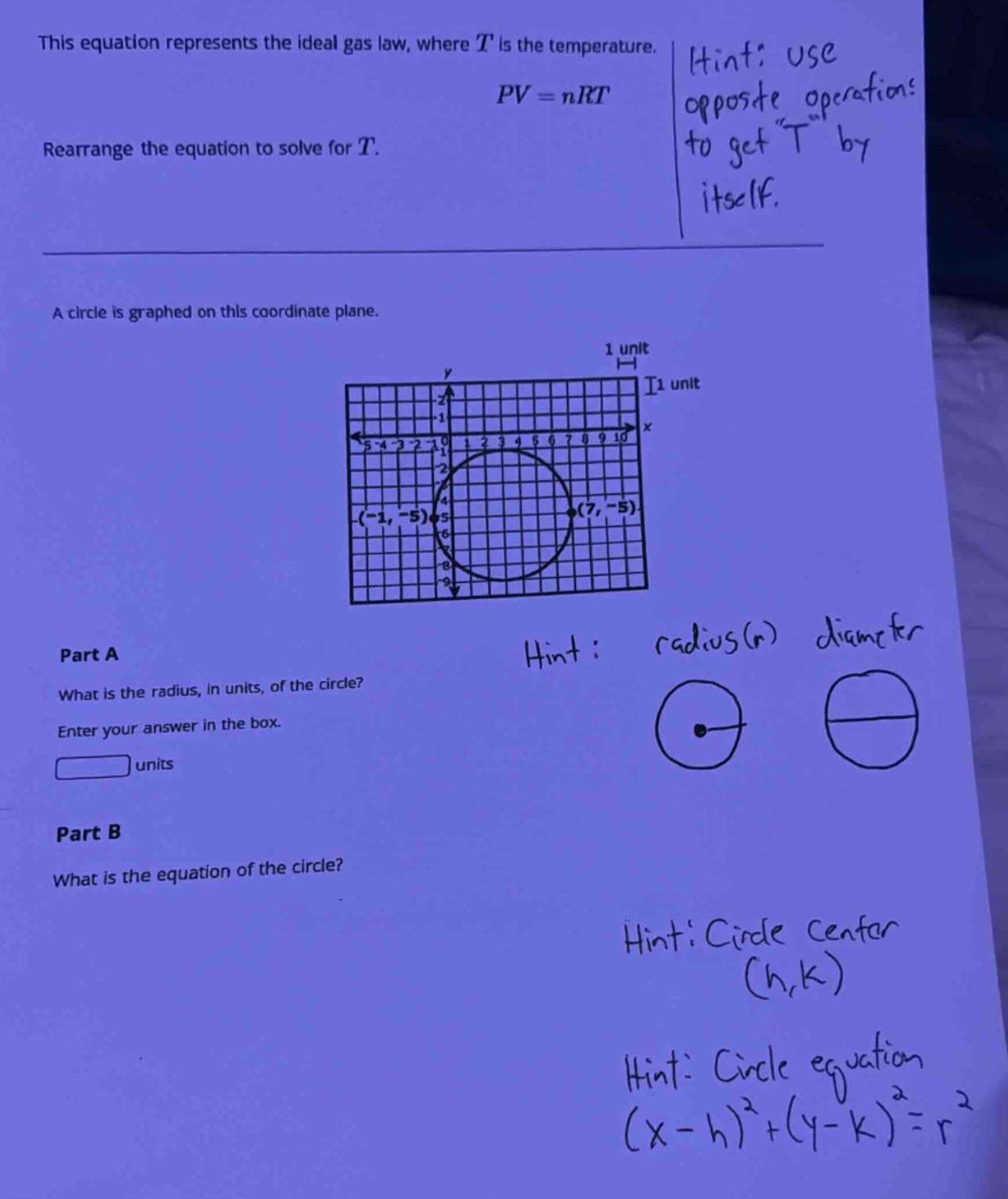
this equation represents the ideal gas law, where (t) is the temperature. (pv = nrt). rearrange the equation to solve for (t). a circle is graphed on this coordinate plane. part a what is the radius, in units, of the circle? enter your answer in the box. units part b what is the equation of the circle?
Answer
Explanation:
Step1: Solve ideal - gas law for T
Given $PV = nRT$, divide both sides by $nR$. $T=\frac{PV}{nR}$
Step2: Find radius of circle
The two points on the circle are $(- 1,-5)$ and $(7,-5)$. The diameter $d$ is the distance between these two points. Using the distance formula for points on a horizontal line (since $y$-coordinates are the same), $d=\vert7 - (-1)\vert=\vert7 + 1\vert = 8$. The radius $r=\frac{d}{2}$, so $r = 4$.
Step3: Find equation of circle
The center of the circle is the mid - point of the diameter. The mid - point of the points $(-1,-5)$ and $(7,-5)$ is $(\frac{-1 + 7}{2},\frac{-5-5}{2})=(3,-5)$. The standard form of a circle equation is $(x - h)^2+(y - k)^2=r^2$, where $(h,k)$ is the center and $r$ is the radius. Here, $h = 3$, $k=-5$, and $r = 4$. So the equation is $(x - 3)^2+(y + 5)^2=16$.
Answer:
For the ideal gas law, $T=\frac{PV}{nR}$; for Part A, 4; for Part B, $(x - 3)^2+(y + 5)^2=16$