latitude and longitude describe locations on the earth with respect to the equator and prime meridian. the…
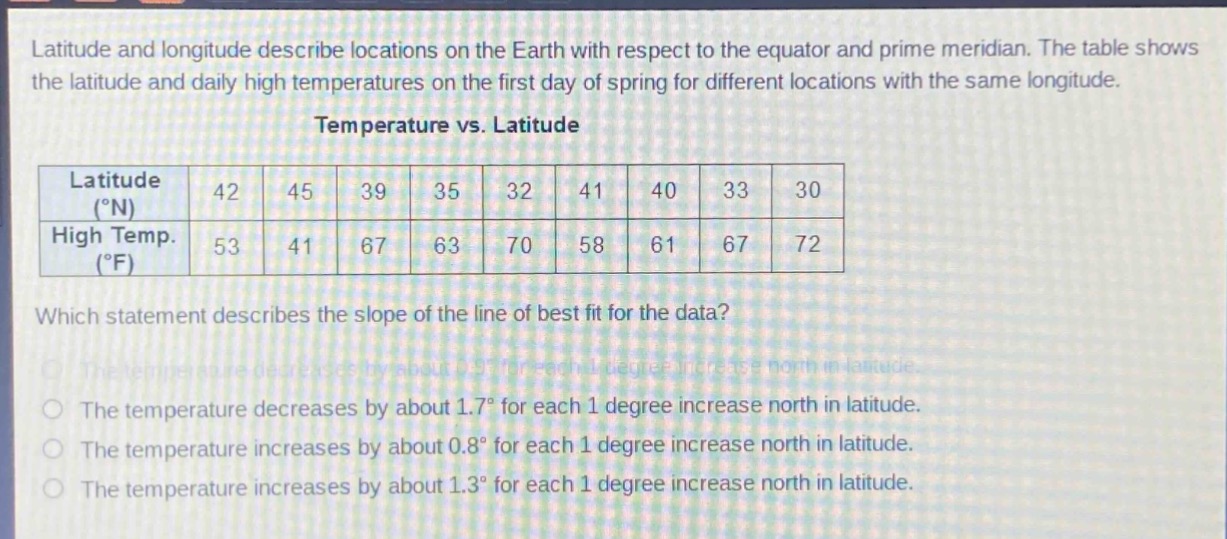
latitude and longitude describe locations on the earth with respect to the equator and prime meridian. the table shows the latitude and daily high temperatures on the first day of spring for different locations with the same longitude.\ntemperature vs. latitude\n| latitude (°n) | 42 | 45 | 39 | 35 | 32 | 41 | 40 | 33 | 30 |\n| high temp. (°f) | 53 | 41 | 67 | 63 | 70 | 58 | 61 | 67 | 72 |\nwhich statement describes the slope of the line of best fit for the data?\nthe temperature decreases by about 0.9° for each 1 degree increase north in latitude.\nthe temperature decreases by about 1.7° for each 1 degree increase north in latitude.\nthe temperature increases by about 0.8° for each 1 degree increase north in latitude.\nthe temperature increases by about 1.3° for each 1 degree increase north in latitude.
Answer
Explanation:
Step1: Recall slope concept
The slope of a line of best - fit in a scatter - plot (latitude vs. temperature here) represents the change in the dependent variable (temperature) for a unit change in the independent variable (latitude). If the slope is negative, the dependent variable decreases as the independent variable increases. If the slope is positive, the dependent variable increases as the independent variable increases.
Step2: Observe the data trend
As the latitude (in degrees north) increases from 30 to 45, the high temperature decreases from 72°F to 41°F.
Step3: Calculate the change in latitude and temperature
The change in latitude $\Delta x=45 - 30=15$ degrees. The change in temperature $\Delta y=41 - 72=- 31$ degrees.
Step4: Calculate the slope
The slope $m=\frac{\Delta y}{\Delta x}=\frac{41 - 72}{45 - 30}=\frac{-31}{15}\approx - 2.07$. But we can also use a more intuitive way. Let's take two points: $(30,72)$ and $(45,41)$. The change in $x$ is $45 - 30 = 15$ and the change in $y$ is $41-72=-31$. A more approximate way is to consider a few more points. If we consider the general trend, as latitude increases, temperature decreases. If we take two adjacent points like $(32,70)$ and $(35,63)$, $\Delta x = 35 - 32=3$ and $\Delta y=63 - 70=-7$, then $m=\frac{-7}{3}\approx - 2.33$. If we consider a larger set of data and do a rough estimate, we know that as latitude increases, temperature decreases. Among the given options, the closest negative - slope value description is that the temperature decreases by about $1.7^{\circ}$ for each 1 degree increase north in latitude.
Answer:
The temperature decreases by about 1.7° for each 1 degree increase north in latitude.