which of the outcomes in this table represent all the favorable outcomes for jorges experiment?\na. (1, 1)…
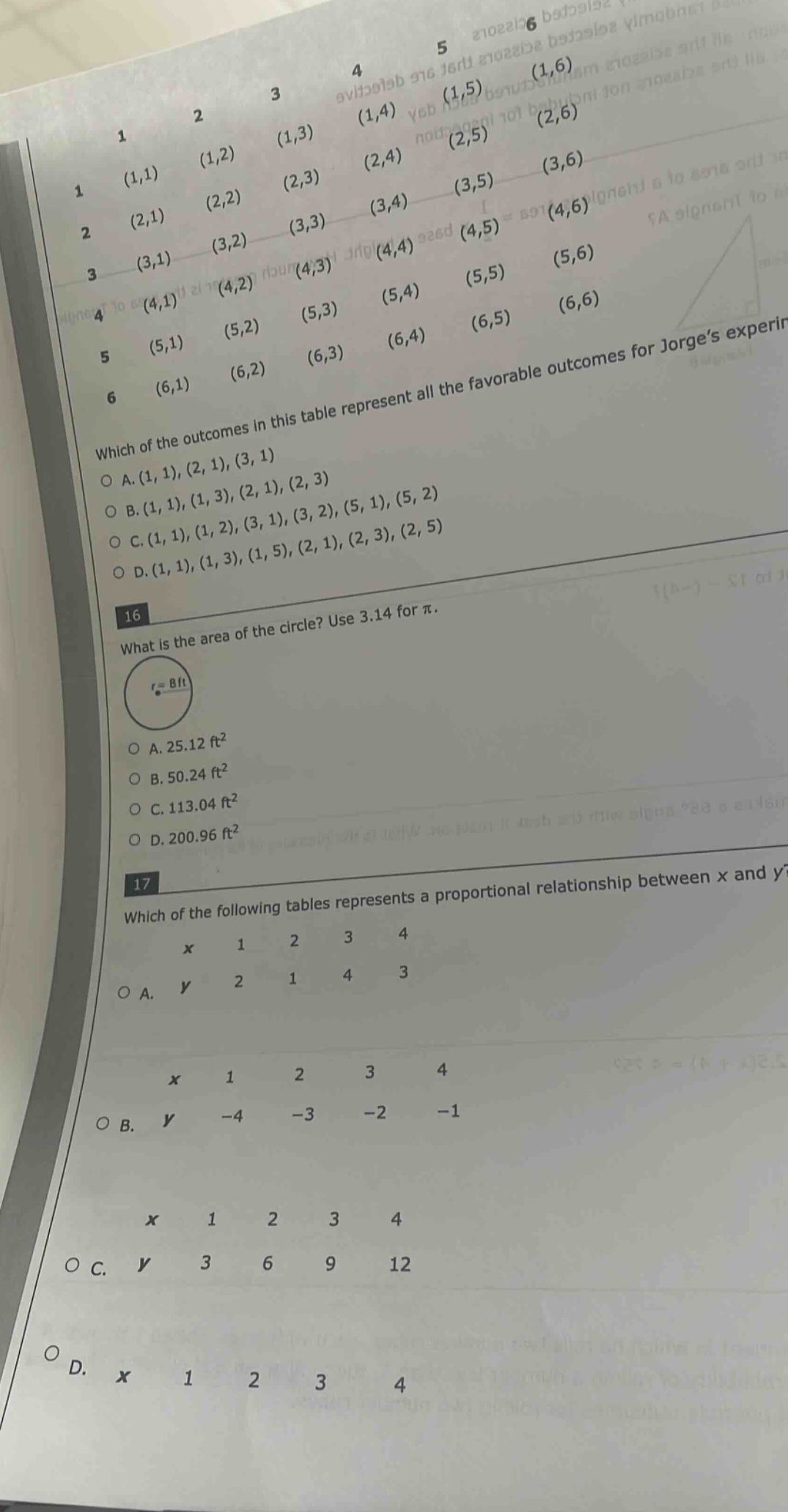
which of the outcomes in this table represent all the favorable outcomes for jorges experiment?\na. (1, 1), (2, 1), (3, 1)\nb. (1, 1), (1, 3), (2, 1), (2, 2), (5, 1), (5, 2)\nc. (1, 1), (1, 2), (3, 1), (3, 2), (2, 1), (2, 3), (2, 5)\nd. (1, 1), (1, 3), (1, 5), (2, 1), (2, 3), (2, 5)\n16\nwhat is the area of the circle? use 3.14 for π.\nr = 8ft\na. 25.12 ft²\nb. 50.24 ft²\nc. 113.04 ft²\nd. 200.96 ft²\n17\nwhich of the following tables represents a proportional relationship between x and y?\na.\nx 1 2 3 4\ny 2 1 4 3\nb.\nx 1 2 3 4\ny -4 -3 -2 -1\nc.\nx 1 2 3 4\ny 3 6 9 12\nd.\nx 1 2 3 4
Answer
Explanation:
Step1: Recall circle - area formula
The formula for the area of a circle is $A = \pi r^{2}$, where $r$ is the radius of the circle.
Step2: Substitute the given radius
Given $r = 8$ ft and $\pi=3.14$, we substitute into the formula: $A=3.14\times8^{2}$.
Step3: Calculate $8^{2}$
$8^{2}=8\times8 = 64$.
Step4: Multiply by $\pi$
$A = 3.14\times64=200.96$ $ft^{2}$.
Answer:
- D. $200.96$ $ft^{2}$
- C. In a proportional relationship, $y=kx$ (where $k$ is a non - zero constant). For option C, when $x = 1,y = 3$; when $x = 2,y = 6$; when $x = 3,y = 9$; when $x = 4,y = 12$. The constant of proportionality $k = 3$ since $y=3x$ for all values of $x$ and $y$ in the table.