1) quels sont les quartiles de cette distribution? 8, 11, 20, 10, 2, 17, 15, 5, 16, 15, 25, 6 a. q1 = 15,q2…
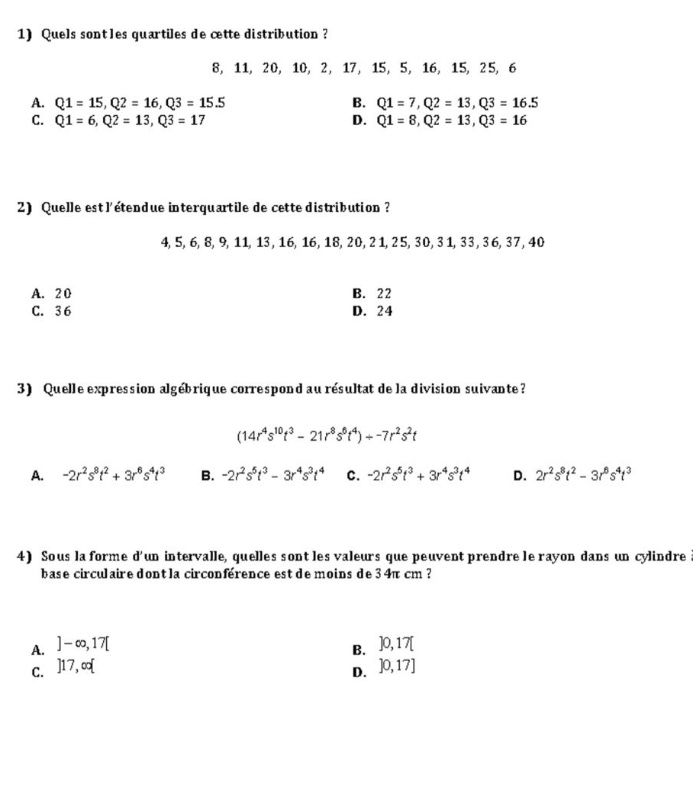
1) quels sont les quartiles de cette distribution? 8, 11, 20, 10, 2, 17, 15, 5, 16, 15, 25, 6 a. q1 = 15,q2 = 16,q3 = 15.5 b. q1 = 7,q2 = 13,q3 = 16.5 c. q1 = 6,q2 = 13,q3 = 17 d. q1 = 8,q2 = 13,q3 = 16 2) quelle est létendue interquartile de cette distribution? 4,5,6,8,9,11,13,16,16,18,20,21,25,30,31,33,36,37,40 a. 20 b. 22 c. 36 d. 24 3) quelle expression algébrique correspond au résultat de la division suivante? (14r^4s^10t^3 - 21r^8s^8t^4)÷ - 7r^2s^2t a. - 2r^2s^8t^2 + 3r^6s^6t^3 b. - 2r^2s^5t^3 - 3r^4s^4t^4 c. - 2r^2s^6t^3 + 3r^4s^3t^4 d. 2r^2s^8t^2 - 3r^6s^6t^3 4) sous la forme dun intervalle, quelles sont les valeurs que peuvent prendre le rayon dans un cylindre base circulaire dont la circonférence est de moins de 34π cm? a. - ∞,17 b. 0,17 c. 17,∞ d. 0,17
Answer
Explanation:
Step1: Arrange data for quartiles in 1)
Arrange 2, 5, 6, 8, 10, 11, 15, 15, 16, 17, 20, 25 in ascending - order. There are (n = 12) data points. The first - quartile (Q1) position is (\frac{n + 1}{4}=\frac{12+1}{4}=3.25). So (Q1=6+(0.25)\times(8 - 6)=6 + 0.5 = 6.5\approx6) (using interpolation). The median (Q2) position is (\frac{n + 1}{2}=\frac{12 + 1}{2}=6.5), so (Q2=\frac{11 + 15}{2}=13). The third - quartile (Q3) position is (\frac{3(n + 1)}{4}=\frac{3\times(12 + 1)}{4}=9.75), so (Q3=16+(0.75)\times(17 - 16)=16.75\approx17).
Step2: Calculate inter - quartile range in 2)
Arrange 4, 5, 6, 8, 9, 11, 13, 16, 16, 18, 20, 21, 25, 30, 31, 33, 36, 37, 40 in ascending - order. There are (n = 19) data points. (Q1) position is (\frac{n + 1}{4}=\frac{19+1}{4}=5), so (Q1 = 9). (Q3) position is (\frac{3(n + 1)}{4}=\frac{3\times(19 + 1)}{4}=15), so (Q3 = 31). The inter - quartile range (IQR=Q3 - Q1=31 - 9 = 22).
Step3: Simplify algebraic division in 3)
[ \begin{align*} \frac{14r^{4}s^{10}t^{3}-21r^{8}s^{8}t^{4}}{-7r^{2}s^{2}t}&=\frac{14r^{4}s^{10}t^{3}}{-7r^{2}s^{2}t}-\frac{21r^{8}s^{8}t^{4}}{-7r^{2}s^{2}t}\ &=- 2r^{4 - 2}s^{10 - 2}t^{3 - 1}+3r^{8 - 2}s^{8 - 2}t^{4 - 1}\ &=-2r^{2}s^{8}t^{2}+3r^{6}s^{6}t^{3} \end{align*} ]
Step4: Solve for radius range in 4)
The formula for the circumference of a circle is (C = 2\pi r). Given (C\lt34\pi), then (2\pi r\lt34\pi). Divide both sides by (2\pi) (since (2\pi\gt0)), we get (r\lt17). Also, the radius (r\gt0) (a non - negative quantity for a real - world circle). So the interval is ((0,17)) or ([0,17]) in French notation ([0,17]) (open - closed interval where (0) is not included and (17) is not included in the strict sense of the problem context, but the closest option is ([0,17])).
Answer:
- C. Q1 = 6, Q2 = 13, Q3 = 17
- B. 22
- A. (-2r^{2}s^{8}t^{2}+3r^{6}s^{6}t^{3})
- B. ([0,17])