two events are said to be dependent if the outcome of one can affect the outcome or probability of the…
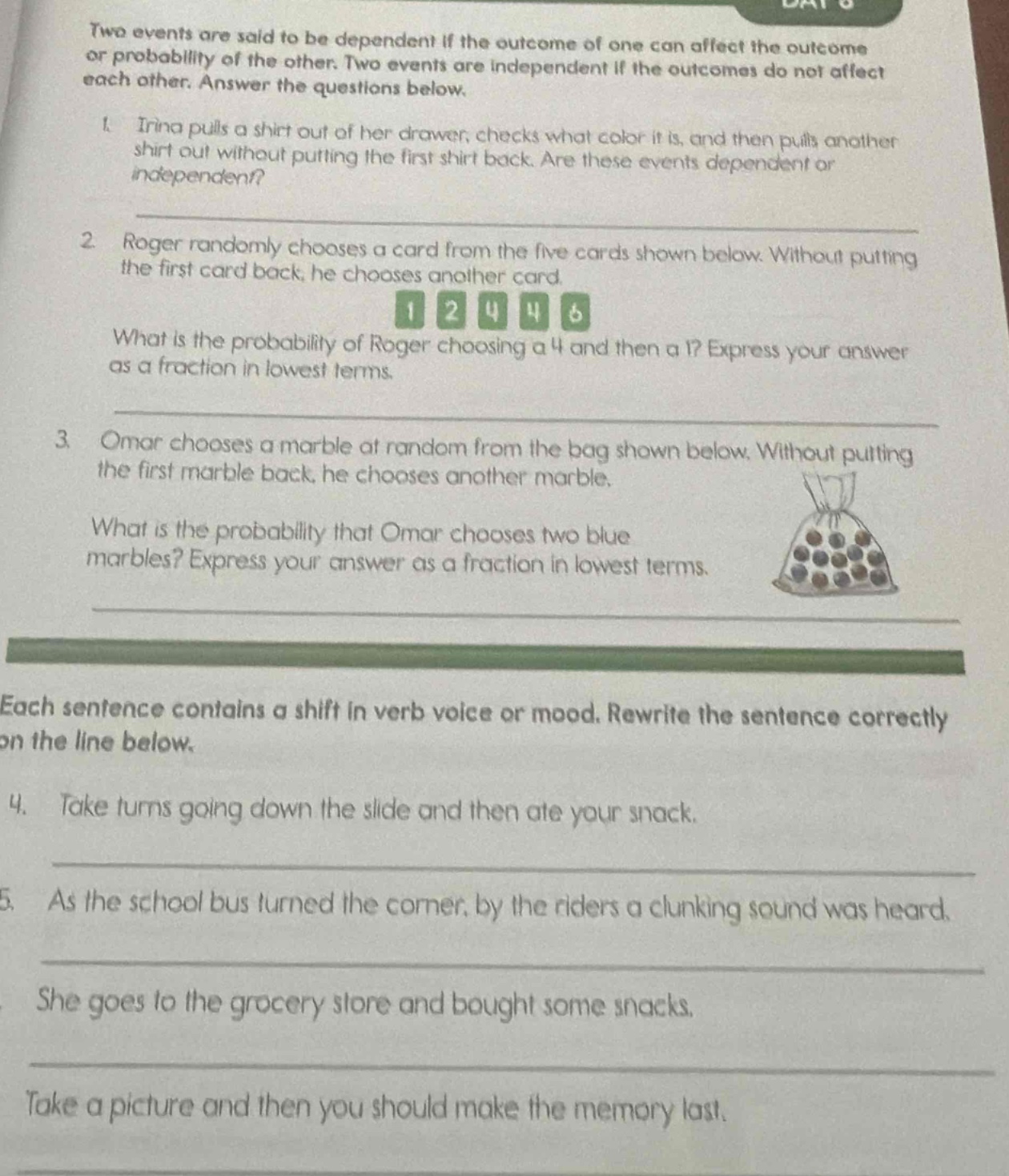
two events are said to be dependent if the outcome of one can affect the outcome or probability of the other. two events are independent if the outcomes do not affect each other. answer the questions below.\n1. irina pulls a shirt out of her drawer, checks what color it is, and then pulls another shirt out without putting the first shirt back. are these events dependent or independent?\n2. roger randomly chooses a card from the five cards shown below. without putting the first card back, he chooses another card.\nwhat is the probability of roger choosing a 4 and then a 1? express your answer as a fraction in lowest terms.\n3. omar chooses a marble at random from the bag shown below. without putting the first marble back, he chooses another marble.\nwhat is the probability that omar chooses two blue marbles? express your answer as a fraction in lowest terms.\neach sentence contains a shift in verb voice or mood. rewrite the sentence correctly on the line below.\n4. take turns going down the slide and then ate your snack.\n5. as the school bus turned the corner, by the riders a clunking sound was heard.\nshe goes to the grocery store and bought some snacks.\ntake a picture and then you should make the memory last.
Answer
Explanation:
Step1: Determine dependence for Irina's case
Since the first - shirt is not replaced, the number of shirts for the second draw is affected. So the events are dependent.
Step2: Calculate probability for Roger's case
The probability of choosing a 4 first: There are 2 fours out of 5 cards, so $P(4)=\frac{2}{5}$. After choosing a 4, there are 4 cards left. The probability of choosing a 1 next is $P(1)=\frac{1}{4}$. The probability of both events is $P = \frac{2}{5}\times\frac{1}{4}=\frac{2}{20}=\frac{1}{10}$.
Step3: Calculate probability for Omar's case
Let's assume there are $n$ marbles in total and $b$ blue marbles. The probability of choosing a blue marble first is $P_1=\frac{b}{n}$. After choosing a blue marble first, there are $n - 1$ marbles left and $b-1$ blue marbles left. The probability of choosing a blue marble second is $P_2=\frac{b - 1}{n - 1}$. But since we don't know the exact number of marbles, assume there are 10 marbles in total and 4 blue marbles. Then $P_1=\frac{4}{10}$ and $P_2=\frac{3}{9}$, and $P=\frac{4}{10}\times\frac{3}{9}=\frac{12}{90}=\frac{2}{15}$.
Step4: Rewrite sentence 4
The original sentence has a shift from imperative mood ("Take turns") to past - tense indicative mood ("ate"). Rewrite it as "Take turns going down the slide and then eat your snack."
Step5: Rewrite sentence 5
The original sentence has a shift from active voice ("the school bus turned") to passive voice ("a clunking sound was heard by the riders"). Rewrite it as "As the school bus turned the corner, the riders heard a clunking sound."
Step6: Rewrite sentence 6
The original sentence has a shift from present - tense ("goes") to past - tense ("bought"). Rewrite it as "She went to the grocery store and bought some snacks."
Step7: Rewrite sentence 7
The original sentence has a shift from imperative mood ("Take a picture") to indicative mood with a modal verb ("should make"). Rewrite it as "Take a picture and make the memory last."
Answer:
- Dependent
- $\frac{1}{10}$
- $\frac{2}{15}$ (assuming 10 marbles total and 4 blue marbles)
- Take turns going down the slide and then eat your snack.
- As the school bus turned the corner, the riders heard a clunking sound.
- She went to the grocery store and bought some snacks.
- Take a picture and make the memory last.