b. (04.01 hc) read the following passage: molten rocks deep inside earth cool and form rock a. the shifting…
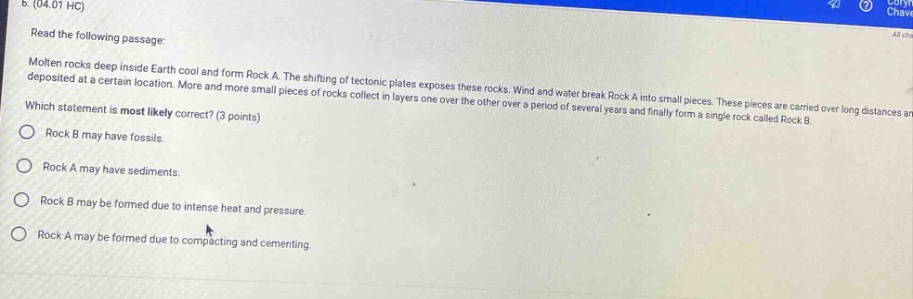
b. (04.01 hc) read the following passage: molten rocks deep inside earth cool and form rock a. the shifting of tectonic plates exposes these rocks. wind and water break rock a into small pieces. these pieces are carried over long distances and deposited at a certain location. more and more small pieces of rocks collect in layers one over the other over a period of several years and finally form a single rock called rock b. which statement is most likely correct? (3 points) rock b may have fossils. rock a may have sediments. rock b may be formed due to intense heat and pressure. rock a may be formed due to compacting and cementing.
Answer
Brief Explanations:
Rock A is formed from molten rock cooling, which is an igneous rock - formation process. Rock B is formed from small pieces of rocks collecting in layers over time, which is a sedimentary rock - formation process. Sedimentary rocks are more likely to contain fossils as they are formed from the accumulation of sediments that may trap organic matter. Igneous rocks like Rock A do not form from sediments, compaction, or cementation and are not formed by intense heat and pressure (which forms metamorphic rocks).
Answer:
Rock B may have fossils.